History of the Collections: The Twentieth Century Onwards

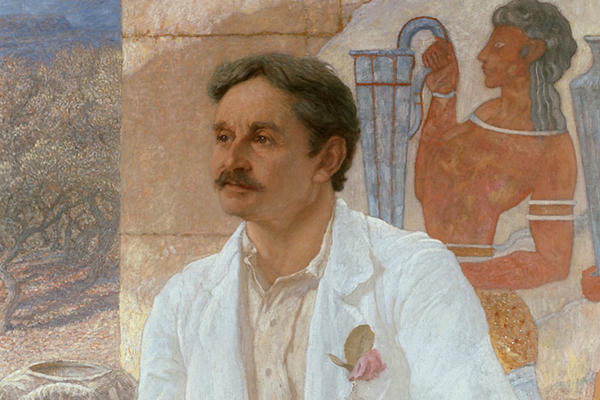
Arthur Evans' father John (now Sir John Evans) died in 1908 and Arthur gave the museum the first part of his father's collection. He gave many gifts of Minoan pottery, figurines, seals, notebooks, drawings and photographs documenting the Knossos excavation. Today the Museum's Minoan, Mycenaean and Cycladic collections are the most comprehensive outside Greece. In 1927 he added his fathers prehistoric collections to the Department of Antiquities.

Arthur Evans resigned as Keeper in 1908 to pursue the excavation programme at Knossos but remained in contact with the Museum until his death in 1941. He was also knighted in 1911.

Evans was succeeded by D. G. Hogarth, who was involved in the excavations at Carchemish in Turkey and who died prematurely in 1927. He was succeeded by Edward Thurlow Leeds, who had been recruited in 1908 to catalogue the Anglo-Saxon collections given by John Evans. In 1913 Leeds wrote The Archaeology of the Anglo-Saxon Period. Leeds had a long career, dying in 1955. He played an important role in the interpretation of the Anglo-Saxon period, and was assisted by the Oxford University Archaeological Society (which he had helped refound after the first world war). The Ashmolean Museum has one of the best collections of Anglo-Saxon material outside the British Museum.

Leeds's interest extended into the Medieval period and it was under his leadership that the foundations of the medieval collections were laid. Excavations in Oxford city by Martyn Jope and Rupert Bruce-Mitford Who followed Leeds, assisted by young enthusiasts such as T.E. Lawrence helped build up the collections. Many acquisitons came into the Department of Antiquities from the rescue excavatations carried out in the 1960s, until the Oxford Archaeological Unit was formed and they took on the responsibility of administering the finds from the excavations.

The formation of the Oxfordshire County Museum Service in the mid 1960s brought an end to the Ashmolean accepting new excavation archives except for existing sites.

The Visitors

1939 Drapers

Beazley

OAU

The Friends of the Ashmolean were founded in 1969 and play an active and important role within the Museum. They make vital contributions towards the purchasing funds for the Museum, and organise the Information Visitors who provide a welcome and help desk for visitors. The group organises a wide variety of activities and events for its members throughout the year.

Young Friends of the Ashmolean is a 'younger' branch of the Friends and was set up to encourage the younger generation, especially students, to develop an interest in art and archaeology. The Young Friends host a programme of events from October to June each year.

YAC

major 20th century acquisitions

The Ashmolean is in the middle of negotiations to purchase the gold painted glass .......... which will become the latest acquisition for the Department of Antiquities.


Links to the booklet Arthur wrote about the Ashmolean and the new pages on the Ash about the redevelopment

Click to enlarge The gold and garnet Ixworth Cross
The Anglo-Saxon gold and garnet Ixworth Cross (AN1927.453), an aquisition of the early 20th century from the Evans' collections

The Anglo-Saxon Ipsden strap ends
The Anglo-Saxon strap ends from Ipsden (AN1997.56-7), an acquisition of the late 20th century. They were found in 1991 at Ipsden, near Henley on Thames and are made of silver and gold.

some words about significant keepers, acquisitions, achievements


all the different departments being formed


Top of Page

© Copyright University of Oxford, Ashmolean Museum, 2006. Last updated: March-2007