| |
Background Information
Japanese Export Art
The eastern end of the gallery, where this bronze figure is exhibited,
contains Japanese art for export to Europe. Works of art produced for
European tastes were very different from those produced for Japanese use,
the latter being more restrained than the former.
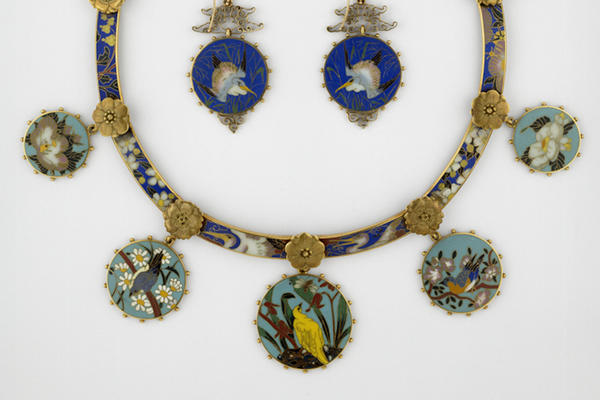
The figure is displayed with objects from the mid-19th to the early 20th
century when Japanese styles were strongly influenced by those from the
West and vice versa, as can be seen from the green and white Art Nouveau-style
vase (EA1997.41) displayed close by.
Meiji
Period
This object was produced during what is known as the Meiji Period. Although
Japan had had an emperor for centuries, real power since the beginning
of the 17th century had been in the hands of the Tokugawa shoguns, heads
of the most powerful aristocratic family. During this period Japan was
cut off from the outside world, but in 1853 American warships under Commodore
Perry sailed in and demanded the opening up of the country.
After fifteen years of unrest the shogun resigned and in 1868 power was
restored to the Emperor in the person of the young, innovative and charismatic
Emperor Meiji, who reigned until 1912. He encouraged the expansion of
international trade and fostered the development of arts and crafts as
an export industry.
The Japan-British Exhibition of 1910
This piece was exhibited at the Japan-British exhibition held at White
City, Shepherds Bush, London in 1910. The exhibition attracted a staggering
8 million visitors and ran for approximately 5 months. It was part of
a series of international exhibitions when both the host and the participating
nations had the chance to show off their achievements and power. This
was the first time Japan took part in such a major international event
and its participation would have been important in building up Japan’s
image as a great power in its own right.
|