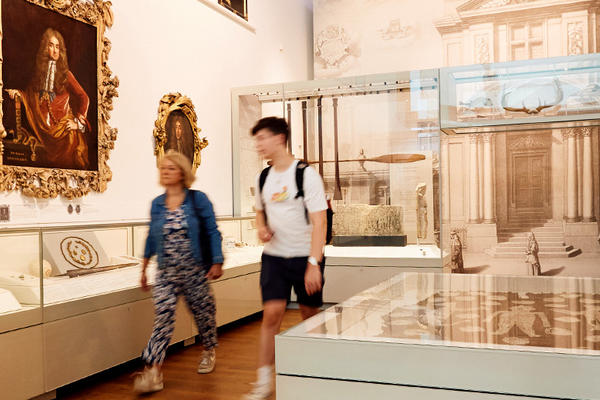
Portrait of John Tradescant the Elder
attr. Cornelis de Neve

Tradescant Room, Gallery 27, First Floor

  Related Objects in the Ashmolean
 

1. Landscape by Sir Nathaniel Bacon
Second case to the right. Towards top left hand corner.

This tiny work is one of eight paintings left to the Ashmolean in the original bequest. Entered in the 1656 catalogue under ‘Mechanick artificiall works in Carvings, Turnings, Sowings and Paintings’, this work is said to be the earliest known landscape by an English-born painter. Both the catalogue entry and the
inscription ‘NB’ which appears on the painting itself, declare it to be by Nathaniel Bacon, although it differs greatly from his other known works which tend to be brighter and less sombre.

 
2. Russian Abacus
Same case as No.1. Top left-hand shelf


This Russian counting machine or shety dates from around 1618 and, as such, it is likely to be the oldest surviving example of such an instrument. It may have been brought back by Tradescant the Elder from his trip to northern Russia in 1618.

3. John Tradescant the Younger, possibly by Thomas de Critz

(pictured below)
Founders Gallery, Gallery 38


Tradescant the Younger stands outdoors wearing the attire of a gardener and holding a gardening implement, possibly a spade. However, his fur-lined jacket indicates that he is a man of some social standing.


4. Elias Ashmole by John Riley, c.1681
(pictured below)
Founders Gallery, Gallery 38

One of the founders of the Ashmolean Museum, Elias Ashmole inherited the Tradescant collection and presented it to the University of Oxford along with his own collection of manuscripts and medals. This portrait was probably painted in order to be presented with his bequest to the University. The frame is by the master woodcarver Grinling Gibbons.


.