| Mosque Lamp, early 14th century
Gallery 24, Islamic Art
This enamelled and gilded glass mosque lamp comes from early 14th-century Egypt. Hanging oil-lamps like this were used widely in mosques in the Islamic world and would have been hung from the ceiling of the mosque with metal chains attached to the three glass handles. As with this example, such lamps were often decorated with part of a famous verse (Verse 24:35, The Light Verse) from the Qur’an.
This lamp was first decorated in gilt and then the motif was outlined with a thin red line before being infilled with coloured enamels. The lamp celebrates Sultan Muhammad ibn Qala’un, whose name appears around the body and who was ruler of Egypt and Syria from c.1299 to 1341.
Islamic Design
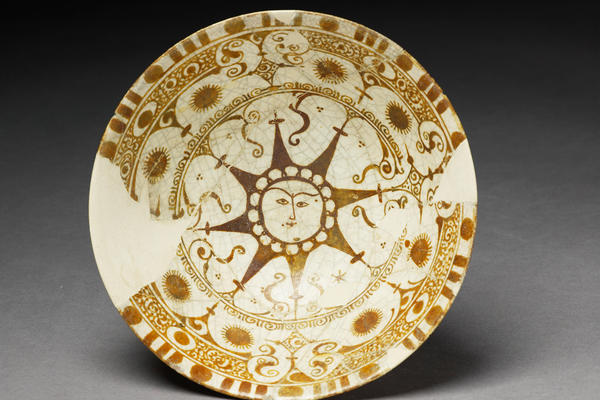
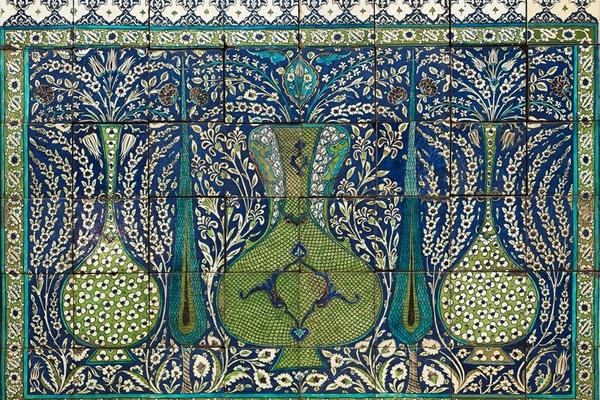
The type of decoration used in Islamic art falls into four main categories: calligraphy, geometric patterns, arabesques and figural designs. Throughout the religion’s history calligraphy has been the main method of disseminating the message of Islam and it is for this reason that it is among the most venerated of art forms. The arabesque scroll pattern derives from a classical scroll design and has come to be seen as one of Islam’s most distinctive motifs. Although the worship of idols is prohibited in Islam the representation of humans and animals is permitted in certain contexts, although not in the decoration of religious buildings or of the Qur’an.
|