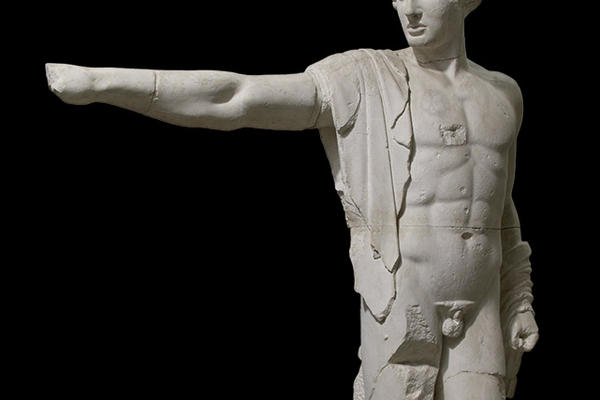
Statue of Apollo, from the Temple of Zeus at Olympia

Original c.460 BC, Cast acquired 1884

Cast Gallery


Focus on the Object

The statue of Apollo

Apollo was the patron of music, poetry and the arts, as well as the god of religious healing and prophesy. He and his twin sister Artemis, the goddess of the hunt, were the offspring of Zeus, the King of the gods. Through his various human oracles, Apollo could reveal the future and the will of his father, Zeus. Apollo’s own temple and oracle at Delphi was the most important religious centre in the Greek world.

The Object of the Month is a cast of the Apollo figure from the centre of the west pediment of the Temple of Zeus at Olympia. The tall god presides over a tumultuous fight between Lapiths and Centaurs. The human Lapiths invited the half-man/half-horse Centaurs to the wedding of Peirithoos, king of the Lapiths. The Centaurs got drunk and assaulted the Lapith women, resulting in a violent fight.

Apollo stands with his right arm stretched out to signify his control. His stern impassive expression is characteristic of the Early Classical Period of Greek sculpture. The hairstyle has tight snail-curls framing the forehead and temples while the hair on top of his head is combed into wavy strands from the crown to the forehead. Apollo was worshiped throughout the Greek world as one of the chief divine guarantors of hellenic culture.

The Cast Gallery’s cast of Apollo

The copy of Apollo in the Cast Gallery was acquired in 1884 from the cast workshop in Berlin. Copies of the statues in the two pediments of the temple were available a few years after they had been found in the German Olympia excavations. The Apollo was one of the first new casts acquired at the time the Oxford cast collection was officially founded. Apollo is mounted on a pedestal made by the Berlin workshop in order to lift the statue to its proper height, had its lower legs and feet been preserved.