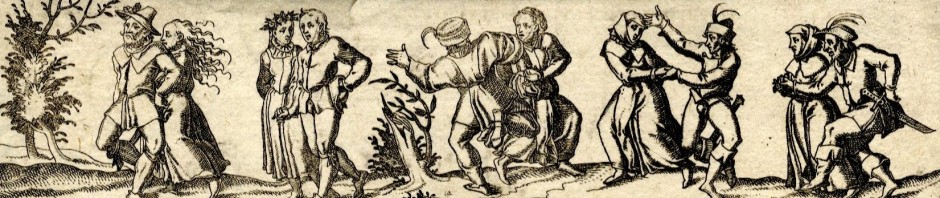
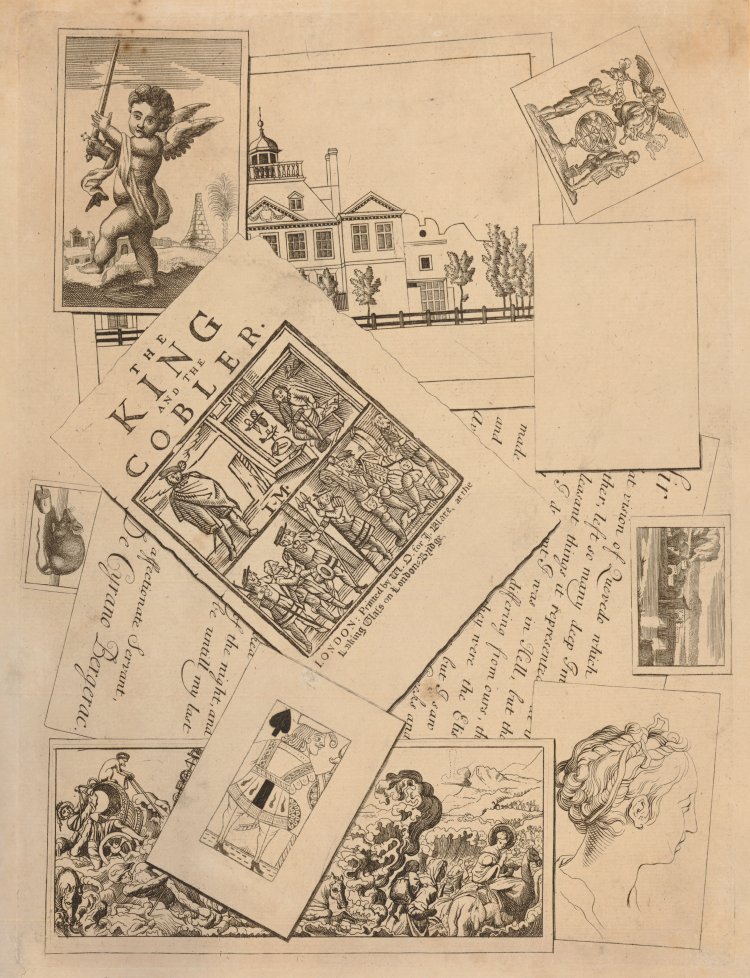
Medley prints like the one below really capture the sense of mixture, the hotchpotch quality, and the endless referencing that characterize Douce’s folders:

Sutton Nicholls, [Medley print] The king and the cobler, 1702-1710, hand-coloured etching and engraving (Ashmolean Museum, Oxford)
Anonymous, Medley print, 1730-60, etching and engraving (London© The Trustees of the British Museum)
Nicholls minutely reproduced the woodcut that illustrated several editions of the story of the merry cobbler enriched at court after entertaining Henry VIII incognito. The chapbook, based on an older ballad, was often reprinted between the late seventeenth and the early nineteenth century. It is a good example of the black letter books that Douce collected and valued as ‘copious stores of information’ resulting from ‘the earlier labours of our countrymen’, as he explained in the preface of his Illustrations of Shakespeare.
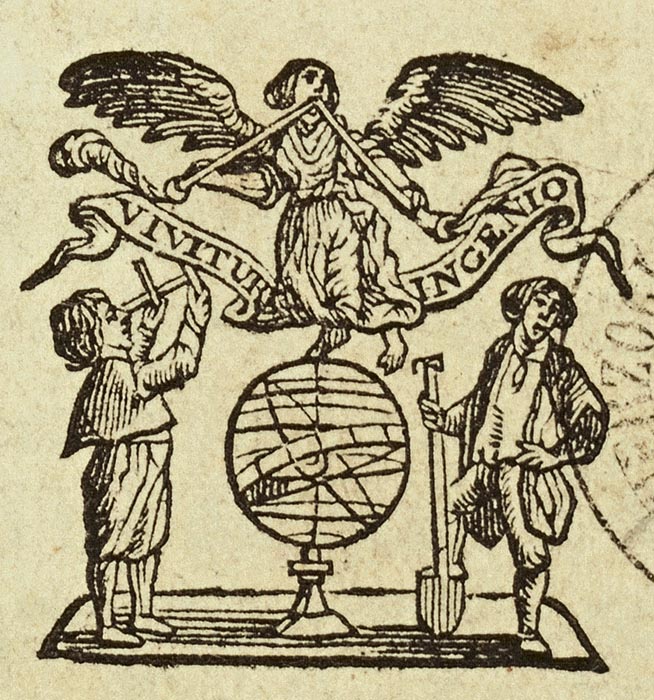
Nicholls proudly displayed his skill as a printmaker by imitating the expressive coarseness of the popular woodcut in another technique (etching). But his virtuosity is also in evidence when trying to replicate different styles, as can be seen in the juxtaposition of the title-page and the more delicate woodcut on the top right corner. The latter was probably copied after a publisher’s device -a very similar woodcut was used, for instance, by the Dutch cartographer Johannes Janssonius (1588-1664). It shows Fame (masked in Nicholls’s version) standing on an armillary sphere, with two men holding a spade and a mathematical instrument below and the motto “Vivitur ingenio”:
Among the remaining scattered prints we see depictions of a mouse, a landscape, Cupid as a boy carrying a sword, the Crossing of the Red Sea, the Jack of Spades, and a female head. A few lines from a letter that seems to reproduce the Lettres Satiriques by Cyrano de Bergerac (1619-1655) can be read below. They refer to the satire published under the title ‘Vision of Hell’ by the Spanish author Francisco de Quevedo in the third part of his Sueños. Needless to say, Douce owned Bergerac’s letters, as well as Quevedo’s works and some curious versions and translations of the latter, such as the Nuits Sévillanes (Brussels, 1700) from which this frontispiece is taken: