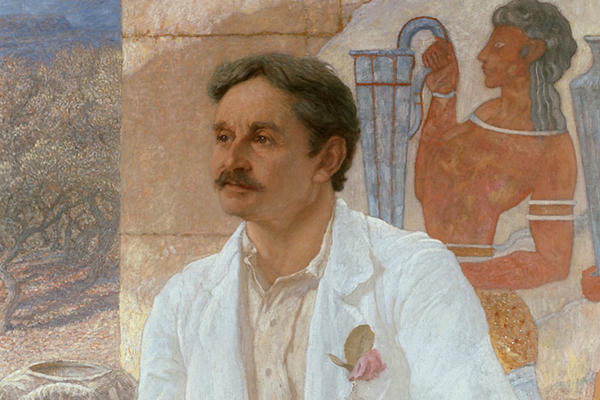
Osbert Guy Stanhope Crawford was born in Bombay on 28 October 1886. He was bought up in London and Hampshire by his maternal aunts after the death of his mother in 1886 and his father in 1894. He was educated Marlborough College and Keble College, Oxford. Initially at Oxford he read Literae Humaniores, but changed to Geography, graduating in 1910. Crawford was a demonstrator in the Department of Geography at Oxford from 1910 to 1911. In 1913 joined the Scoresby Routledge expedition to Easter Island, but left after a quarrel with the leaders. He then joined Henry Wellcome at Jebel Moya and Abu Gelli in the Sudan. He also took part in the excavations at Longbarrow on Wexcome Down with E. A. Hooten. |
![]() O G S Crawford with his motobike (Ashmolean Museum Archive) |
During the First World War Crawford served as an infantryman with the London Scottish and then as a subaltern in the Third Army's map department (later the Field Survey Battalion). In 1917 he was an observer with Royal Flying Corps. His aircraft was shot down in 1918 and he remained a prisoner at Holzminden until end of the war. In 1920 he was appointed Archaeological Officer at the Ordnance Survey from which he retired in 1946. During the Second World War Crawford stored historical material in his garage at Nurslings when the Ordnance Survey offices at Southampton were burnt during an air-raid. Crawford also founded the quarterly review of archaeology, Antiquity, in 1927. It was during his time as an observer in the First World War that Crawford realized it was possible to see archaeological features on aerial photographs. In March 1923 he gave a lecture entitled ‘Celtic Fields’ to the Royal Geographical Society based on photographs taken in 1922. Then in 1924 he carried out the first season of aerial photography, initially using an Avro trainer supplied by the De Haviland company and a captured German camera, but later the aeroplane was replaced by the more responsive De Haviland 9. One of Crawford's flight log from this period has survived and is held in the Ashmolean Museum. |
|
| His archaeological contempories included G.P.M. Insoll, Major George Allen, C.E. Curwen and Derrick Riley. His many publications include:
Crawford dies on 28 November 1975. His camera and manuscript roll are now in the Ashmolean Museum. |
|
Further articles about Crawford can be found in: Antiquity Vol. 32 No. 125, March 1958, pp 3-5, Obituary by Mortimer Wheeler; |
|
|
|