| |
The first four
are in the same gallery as the Death Mask
1. Cromwell's Silver
Watch
Gallery 27, first floor
2. Spurs of King Charles I
Gallery 27, first floor
3. Spurs of John Hampden
Gallery 27, first floor
John Hampden was Oliver Cromwell's cousin. His objection to the 'Ship
Money' (a new tax levied by parliament under Charles I) is thought to
have been the one of the catalysts that started the Civil War in 1642.
4. Cromwell's Privy Seal
Gallery 27, first floor
The King's seal was used to authenticate important documents. On one side
it showed the King crowned in majesty with his sceptre and orb in his
hands; on the other side he appeared as a warrior, dressed in armour.
On 15th February 1655 the Great Seal was altered for use by Cromwell,
the Lord Protector. The Ashmolean example shows him mounted on horseback
as a warrior protector on one side, but without a crown. On the other
side are the arms of the Commonwealth, with an imperial crown on the helmet
symbol.
5.
Pattern Crown Piece (Coin) of Oliver Cromwell
Coin Room Lobby, Gallery 36, first floor
After the execution of Charles I, the King's head, which usually appeared
on coinage, was replaced by a cross, a palm and laurel, or a cross
and harp. In 1656 and 1658 Cromwell, as Lord Protector, had his own
coins minted, one of which you can see in the Ashmolean Coin Room
Lobby. Designed by Thomas Simon, one of the finest of England's medallists,
these coins were never actually put into circulation. On the obverse
of the coin we see Cromwell crowned with the laurels of antiquity,
like a Roman Emperor. On the reverse we see Cromwell's arms and those
of the Commonwealth. He is described in the legend inscribed on the
coin as Protector ('PRO'), not Rex. |
 |
6.
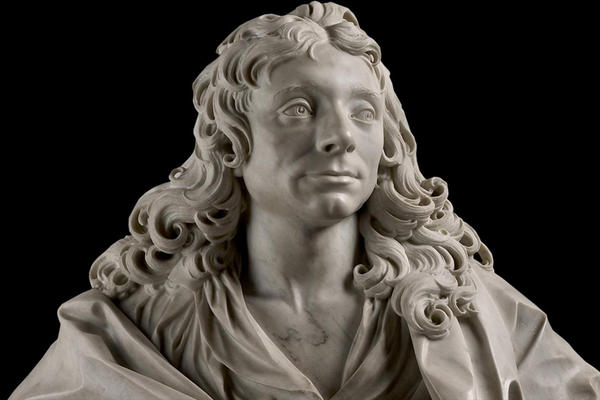
Marble Bust of Oliver Cromwell
Gallery 40, first floor
This bust
is made from marble and measures 60cm high. It shows Cromwell in contemporary
dress (you can see his shirt collar), but non-contemporary, elaborate
armour. The bust is thought to be by Edward Pierce, but it has also
been argued to be the work of Joseph Nollekens. The source for his
facial features was probably a death mask. |
 |
|