| |
Oliver Cromwell died on 3rd September 1658 in Whitehall Place. When
he died, a wax mould was made of his features and was most probably kept
by its maker, Thomas Simon. Seven weeks after his death a wooden effigy
and wax replica of his face (made from the cast) were laid in state at
Somerset House.
Contemporary sources record that this effigy held an orb and sceptre
and wore a velvet cap lined with ermine (a symbol of royalty). Behind
him was the crown. Later the effigy was moved to another room, sitting
upright with the crown positioned on its head - in effect a posthumous
coronation. One effigy is said to have been burned at Westminster in May
1660 and the other hanged by the neck at Whitehall in June 1660 when Charles
II was restored to the throne.
Plaster-casts were made from the original wax mould and many now
exist in museums both in this country (such as the Museum of London and
the National Portrait Gallery, London) and abroad. Ours was cast in the
1800s.
If you look closely at the mask, you can see what a striking image
it conveys of this once powerful man. It is, by its nature, a true likeness
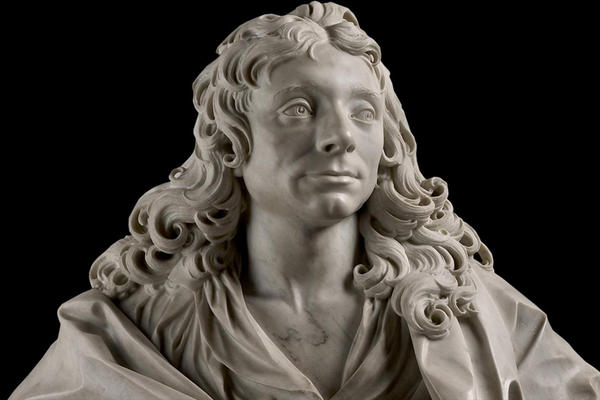
and it is interesting to compare this representation of Cromwell with
the others in the Ashmolean Museum (see Related Objects).
|