| |
Related
Objects in the Ashmolean Museum
All these objects highlight the widespread influence of ancient Greek
myths.
1. Five Pound Piece of George III, 1820
Coin Room Landing, Gallery 36, same case as Object of the Month.
This coin, struck with an image of St George and the Dragon, is displayed
with that of Bellerophon slaying the chimaera to highlight their remarkable
similarity. Images of St George and the Dragon were based on classical
Greek depictions of Greek heroes on horseback slaying monsters, so it
is not surprising that these two objects are similar. The decision to
introduce an image of St George onto British coins of George III would
have flattered King George, much as the use of an image from classical
Greece would have flattered the Roman Emperor Antoninus Pius.
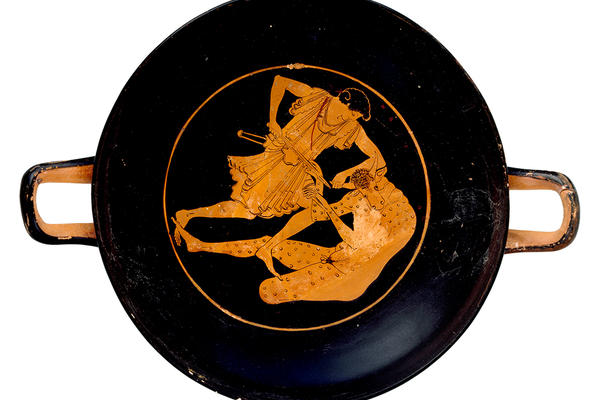
2. Ancient Greek Pot Showing Heracles Fighting the Nemean Lion.
Gallery 33, First Floor, Case 8, Daily Life.
According to
ancient Greek mythology Heracles, the son of Zeus, was set twelve seemingly
impossible tasks, called 'The Twelve Labours of Heracles'. This ancient
Greek pot, from the 6/5th century BC, shows the first of these labours,
in which the hero had to slay the Nemean lion. Apparently, after slaying
the lion, he removed the skin and wore it like a cloak to prove he had
carried out the task. The Labours of Heracles were similar to the task
Bellerophon was set and the feats of both mythical heroes were used to
decorate coins in Roman Egypt around the same time.
3. Byzantine Icon.
Gallery 3, Ground Floor (at the foot of the stairs leading from the Coin
Room Lobby).
This painted icon with a Greek inscription is probably from 15th century
Cyprus and shows St George slaying a dragon. Like that of the George III
coin, this imagery was borrowed from classical Greece. Icons are used
in churches for the worship of a particular saint or holy figure, often
the Virgin and Child.
|