|
1.
Other watches
The earliest form of mechanical
timekeeper made use of a cord wound round a drum with a weight fixed
to the loose end. As the drum is turned, the hands of the clock
rotate. In order to regulate the speed at which the cord unwinds,
the mechanism incorporates an “escapement”, a device
which stops and releases the wheel at regular intervals with an
audible “tick-tock”. Clocks like this could not easily
be moved but were ideal for public buildings or for shelves in a
domestic interior where they occupied a fixed location (see the
brass “lantern” clock in Gallery 38, Founders Collection).
Portable clocks and watches were made possible with the invention
of the coiled watchspring in the mid-fifteenth century. This spring
is tightened with a key and as it unwinds, it turns the hands on
the dial. Because a coiled spring exerts increasingly less pressure
as it unwinds, all clocks and watches which operate with a spring
make use of a device which ensures that the hands will not turn
more slowly as the spring runs down. The stop-start effect of the
“escapement”, meanwhile, prevents the spring from instantly
unwinding.
The earliest
surviving watches, which date from the first half of the sixteenth
century, are either drum-shaped (like nos. 2 and 3 in the wall case
in Gallery 52 Silver & Watches ) or ball-shaped (no. 1).
At first, they were carried by a cord round the neck but with the
growing popularity of pockets in the seventeenth century, they began
to be carried in the pocket and were secured to the owner’s
costume by a chain. Women carried them like a bunch of keys, suspended
by the chain from a belt (see the two mid-seventeenth century portraits
of Hester Tradescant in Gallery 38 Founders Collection).
|

German
Sperical Watch, Anon.
|
|
2. The watch
in art
The
use of the watch became widespread in the course of the seventeenth
century. It appears with great frequency in Dutch and Flemish still-life
painting as a symbol of passing time. Flowers which quickly fade
appear alongside watches, often attached to the blue ribbon by which
they were then suspended. There are nine paintings in the Ashmolean’s
collection of still-life paintings which feature watches, that can
be seen in Gallery 57 (Dutch & Flemish Still Life Paintings).
Sometimes the watch itself was fashioned as a symbol of mortality
(see the skull-shaped watches nos 42 and 43 in the display in Gallery
52 (Silver & Watches) and brightly coloured flowers often decorate
the enamelled cases (for example: nos. 81 to 84).
|

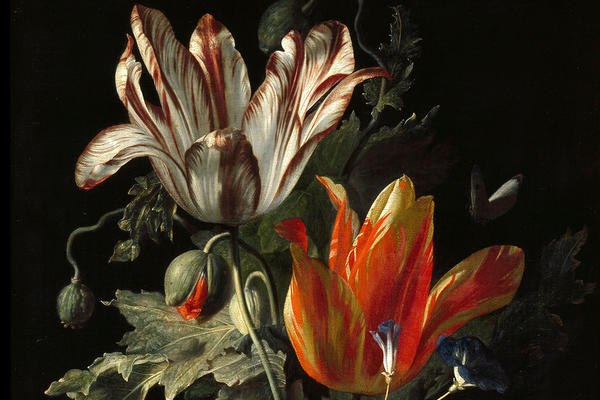
Detail of Jan Philip
Van Thielen's
Still Life of Flowers
c.1660
|