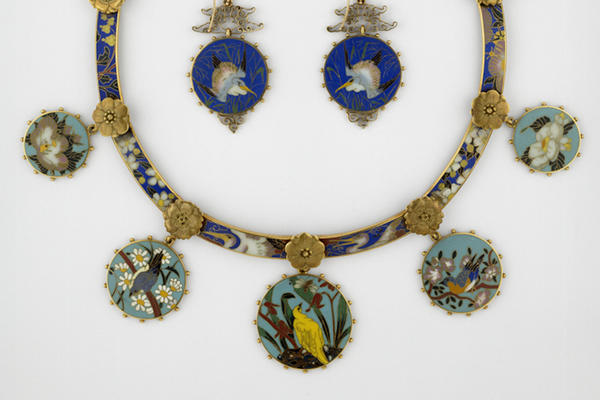
This
wonderful cloisonné enamel vase was made by the fine Japanese
artist-craftsman Namikawa Yasuyuki, in Kyoto, shortly before he
retired in 1915. It represents the culmination of his skill acquired
over a lifetime.
Cloisonné
enamel
Cloisonné is made by the fusion of powdered glass onto
a copper or other metal body. The colours are separated by strips
of metal, on edge, called cloisons which delineated the picture
or pattern to be formed. Repeated firings in a kiln, and polishing
between each, were required to obtain the smooth surface characteristic
of the finest cloisonné.
Japanese
cloisonné
The making of cloisonné is not an old Japanese tradition,
and the making of objects of any size only began in the 1830s,
when, it is said, Kaji Tsunekichi tried to copy a Chinese piece.
The craft developed slowly at first, and until the 1870s the colours
were poor and the execution crude. After that time, however, the
increase in the skill of the many craftmen and small factories
that made cloisonné was phenomenal. We can follow this
increase in skill and the change in taste of that time, when Western
demand influenced all the arts of Japan, in the work of Namikawa
Yausuyuki, arguably the finest cloisonné artist of all
time.