About the Object
The stories in the embroidered pictures
The casket takes the
popular biblical story of Abraham and his family as its theme
(Genesis 16: 21 and 24). As the founder of the Hebrew nation,
Abraham was a model for kings, and in the 17th century lessons
about heritage and succession were drawn from his biblical role
in English sermons, writings and visual images. Similarly the
stories of Sarah, Hagar and Rebecca offered moralizing tales of
marriage, legitimacy and the proper behaviour of women as wives
and mothers. The recurrence of these themes in embroideries attests
to their familiarity at home and at school, and to their role
in the education of young women.
The lid shows Sarah with her son Isaac, Abraham’s legitimate heir. On the left door, Abraham dismisses his mistress, Hagar, together with her son Ishmael, as Sarah had requested once Isaac was born. On the right, Hagar in the desert prays for help while Ishmael lies faint beneath a tree; a well miraculously appears. On the right side of the box, Abraham instructs his steward Eliezer to find a suitable wife for Isaac, and on the back Eliezer meets Rebecca, who gives him water from a well. The last scene on the left side presents a fashionably dressed couple, probably Rebecca and Isaac. Attractive motifs of animals, flowers and foliage animate the upper parts of the casket.
Making the embroideries
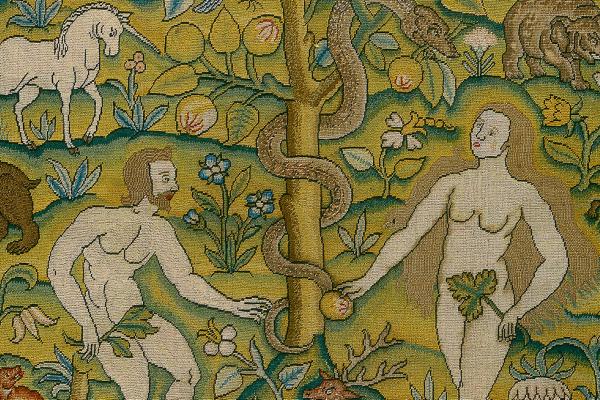
Embroidery designs
were usually taken from prints and here the scene of Rebecca at
the Well has some affinities with an engraving by Gerard de Jode.
Probably the teacher or the embroiderer herself was able to choose
combinations of figures and decorative elements from ready-made
patterns to make up images with a more individual flavour. The
raised work areas are worked on a silk satin ground; the three-dimensional
figures are constructed from sections of detached needlepoint
padded with silk thread. Their hands are formed by thick wire
wrapped in silk, while collars and cuffs are made from applied
sections of detached needlepoint lace in fine linen thread. A
variety of materials are used: some human hair may lie beneath
the finer silk wrapped coiled metal wire forming the figures’
hair, while peacock feather remains can be seen in the raised
work caterpillar on the lid. The pictures on the back and sides
of the casket were made with tent stitch.