
THE HISTORY OF BRITAIN'S BEST-LOVED BLOOMS


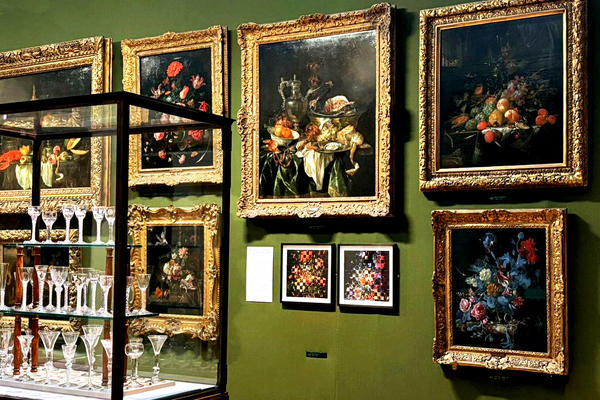
Gallery 1 in the In Bloom exhibition
Scientific plant collecting grew between the 1600s and the 1700s in England. Passionate naturalists gathered and exchanged previously undocumented seeds and plant specimens from near and far, adding momentum to the fast-developing science of botany.
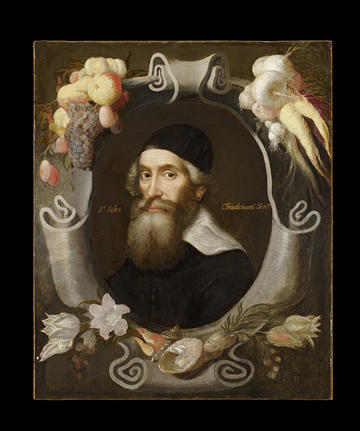
John Tradescant the Elder, attributed to Emanuel de Critz,1638-1665, oil on canvas © Ashmolean Museum
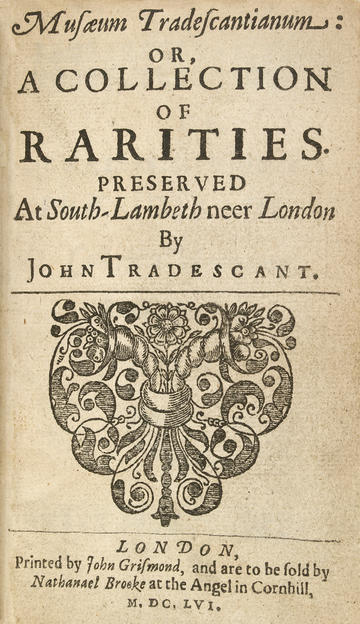
Musaeum Tradescantianum title page, John Tradescant the Younger, 1656 © Royal Collection Trust

John Tradescant the Younger as a Gardener, attributed to Thomas de Critz, 1648–1653, oil on canvas © Ashmolean Museum
Amongst these naturalists were the founders of the Ashmolean Museum collection: John Tradescant the Elder and John Tradescant the Younger. Alongside amassing the curiosities that would form the core of our Museum, these father-and-son gardeners were also responsible for bringing in new plant species through their travels, from varieties of apricots and quinces to new types of jasmine, lilac, and gladioli. The distinctive-looking Liriodendron or tulip tree – a member of the magnolia family which blooms in summer – was one such species introduced to England from North America by Tradescant the Younger.

The Tulip Tree, Georg Dionysius Ehret, c. 1750-70, watercolour and graphite on paper © Ashmolean Museum, WA2020.128, bequeathed by Iris Goodacre
In this process, the Tradescants benefited from the insights of a network of local and foreign nurserymen and horticulturalists who eagerly shared their findings and discoveries. Mary Somerset, the first Duchess of Beaufort, and Jacob Bobart the Elder, the first Superintendent of the Oxford Botanic Garden, were among them.
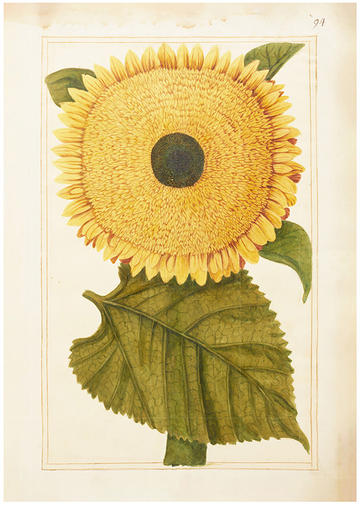
Annual sunflower (Helianthus annuus), Everard Kick & Daniel Frankcom, from the Florilegium, commissioned by Mary Somerset, Duchess of Beaufort, 1703, bound volume with watercolours © The Duke and Duchess of Beaufort, Badminton Estate, Gloucestershire
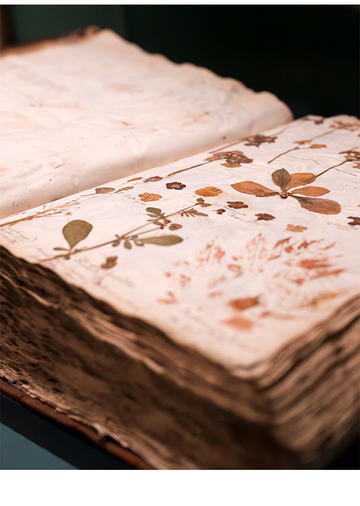
The Hortus Siccus of Jacob Bobart the Elder and Jacob Bobart the Younger with dried & pressed plant specimens mounted on paper © Oxford University Herbaria, Department of Biology, BSn-A33r
This group further relied on the support of aristocratic patrons, who offered the means and the stimulus for new explorations and acquisitions overseas. Their connections with learned societies and academic institutions further enriched and galvanised scientific endeavours.
The 1700s revolutionised the study and appreciation of plants through significant plant-hunting expeditions.
These included research trips to the south Mediterranean, the Americas, and Oceania, which relied on the contacts and infrastructure built in the previous century. As a direct consequence, more specimens were circulated around the world than ever before, impacting the landscapes and ecosystems of both the plants’ countries of origin and their new homes.
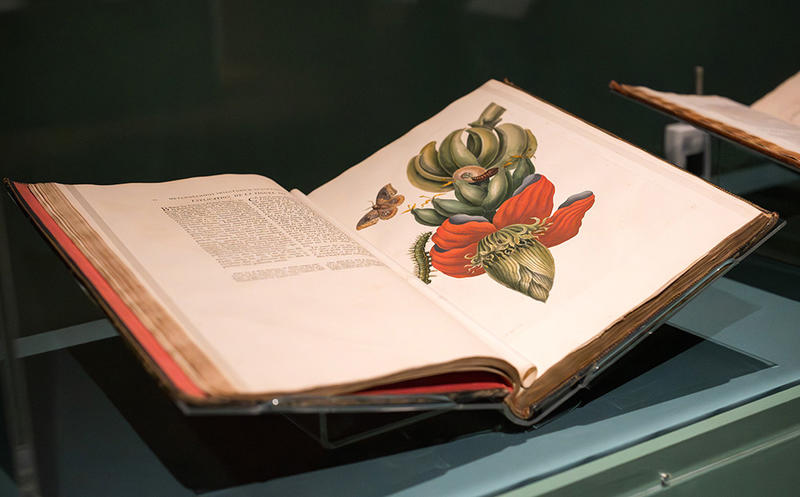
Banana blossom with life stages of the Bullseye moth, illustration from 'Metamorphosis of Surinam's Insects', by Maria Sibylla Merian, 1726, coloured engraving © Bodleian Libraries
This flora was also documented through a series of landmark publications, which contributed to the rising popularity of plant studies. Some of these books, produced as expensive limited editions, were illustrated with exceptional paintings, reflecting the rise of botanical illustration as a distinctive artistic genre.
Professor of Botany John Sibthorp’s collaboration with Ferdinand Bauer, perhaps the greatest botanical artist of his time, survives in field sketches and original watercolours that are now amongst the treasures of the University of Oxford's collections.

Spotted Arum (Arum dioscoridis), Ferdinand Bauer, 1788-1794, watercolour on paper for John Sibthorps’s Flora Graeca © Sherardian Library, Bodleian Libraries, MS. Sherard 245, fol. 56

Models for teaching plant morphology by Robert and Reinhold Brendel on display in the In Bloom exhibition
Over the late 1700s and 1800s, the knowledge gathered through such scientific and artistic endeavours was systematised and disseminated through revolutionary strides, like Carl Linnaeus’ attempts at organising the natural world. Pedagogy of plant sciences, too, made progress, with employment of new teaching aids, instruments and techniques.
Linnaeus' classification of plants based on sexual organs was a watershed in the history of botany.
Botanical illustration helped to popularise and publicise these advances. John Miller's detailed plates, illustrating Linnaeus' system, were hailed by Linnaeus himself as 'the most beautiful and accurate'
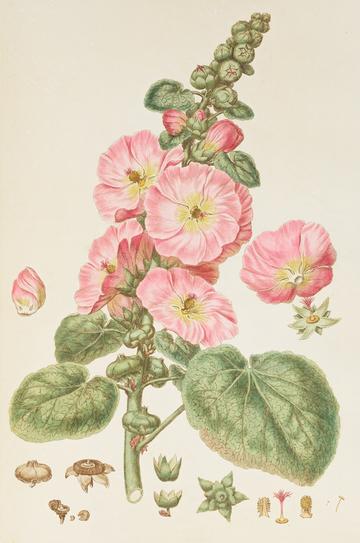
Hollyhock (Alcea rosea), John Miller from Illustratio systema sexualis Linnaei, vol I, 1770-1777, hand coloured engraving © Bodleian Libraries, Arc. Nat. Hist. I 5-7, fol.59
As the world opened up through exploration and trade, business boomed. New and exotic plants with distinctive flowers and alluring scents became highly fashionable additions to European gardens and estates.
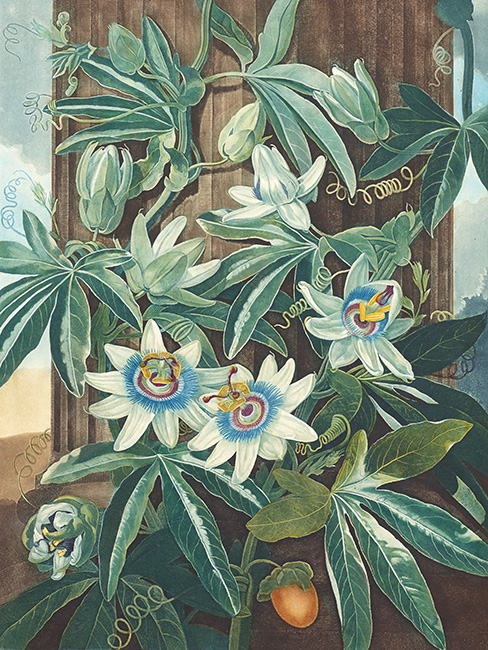
The Blue Passion Flower (Passiflora caerulea), James Caldwell after Philip Reinagle, from Robert J. Thornton’s The Temple of Flora 1798–1810, bound volume with coloured engravings © The Bodleian Libraries, University of Oxford, CR.L.50, p.247
These, in turn, stimulated new local varieties and hybrids, driven by individual taste and different growing conditions. What was once rare and foreign was gradually naturalised, bringing the world into people’s back gardens.
Trade in ornamental species remained lucrative for generations of merchants and nurserymen, sustaining social mobility and feeding cyclical ‘florimanias’, or crazes for ornamental flowers. Perhaps, the most famous was ‘tulipomania’, that gripped the Dutch Republic in the 1630s. Two centuries after people were still wondering why someone would pay the price of a canal-side house for a shrivelled bulb! Holland’s irrational pursuit of this elusive flower surely reflected the new fashions and surplus income of the rising middle class. But it also spoke of the huge financial gains that could be made in the business of ornamental plants from the 17th century onwards. Like tulips, other flowers were equally affected by an economic mindset.
Alongside ornamental plants and flowers, a demand for new breeds, a growing interest in gardens, and fashionable recreational activities led to large-scale commodification of plants, which began to alter our relationship with the natural world.
Species with a strong economic potential – from recreational and medicinal plants like tea or the opium poppy, to those with industrial applications, such as rubber and dyestuff – triggered strong competition for monopoly, especially amongst joint stock companies.

Poppy seed pod, Brigid Edwards,1999, watercolour over pencil © Brigid Edwards, courtesy of the Shirley Sherwood Collection
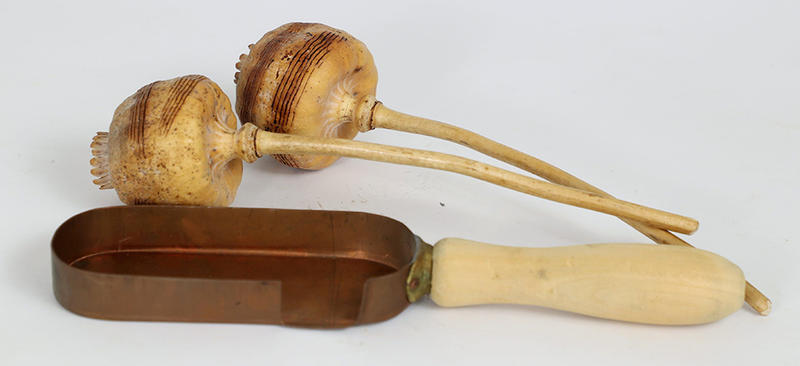
Dried opium poppy seed heads of Papaver somniferum and an implement for collecting resin, 19th–20th century, wood & copper, botanical specimens © The Board of Trustees of the Royal Botanic Gardens, Kew, 71993
This entrepreneurial spirit eventually informed colonial policies and practices, with the extractive priorities of botanical knowledge and resources, in particular, proving essential for the prosperity of the British Empire.
The painting of plants for illustration purposes, and not just for scientific study, goes back to ancient times and can be seen in murals dating from early Greek and Roman eras. Botanical drawing has also had a long history. The artistic representation of plants is evident in the exquisite drawings of Leonardo da Vinci – who studied the structure of his subjects minutely.
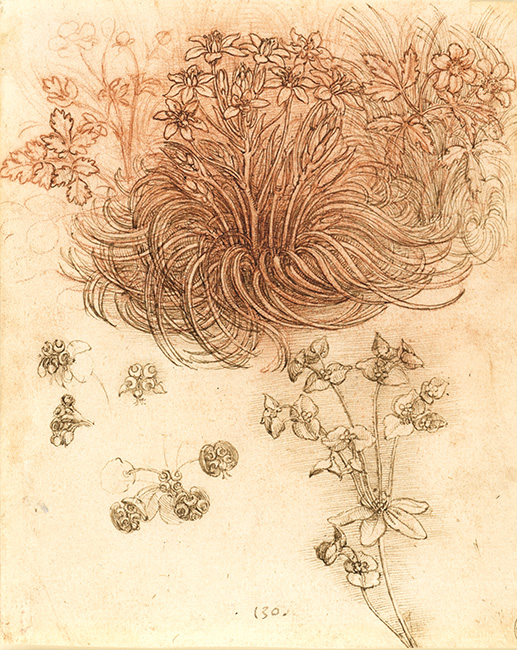
Star-of-Bethlehem, Wood anemone and Spurge, Leonardo da Vinci, c.1506–12, pen & ink over red chalk on paper © Royal Collection Enterprises Ltd 2026 | Royal Collection Trust / Bridgeman Images (not in the In Bloom exhibition)
In the 18th and 19th centuries, systematic collection, classification and dissemination of plant knowledge led to the development of botanical art as a distinct genre. It was augmented by social phenomena – like the craze for ornamental flowers. Dutch still lifes turned flora into a triumph of natural wonder and human skill.
Simon Verelst’s spectacular vase with tulips displays the highly desirable ‘broken’ tulips with their variegated petals. Seventeenth-century plant-breeders strived to achieve this feature and miserably failed – it was only in the 20th century that it became known it was the result of a virus infecting the tulip bulbs.
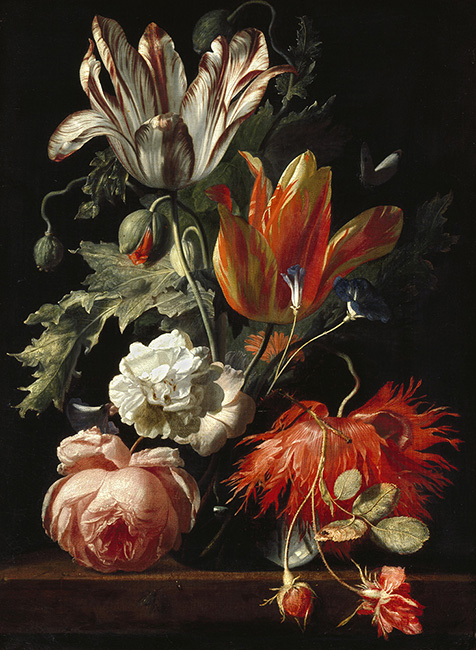
A Vase of Flowers, Simon Verelst, c. 1669–1675, oil on canvas, © Ashmolean Museum
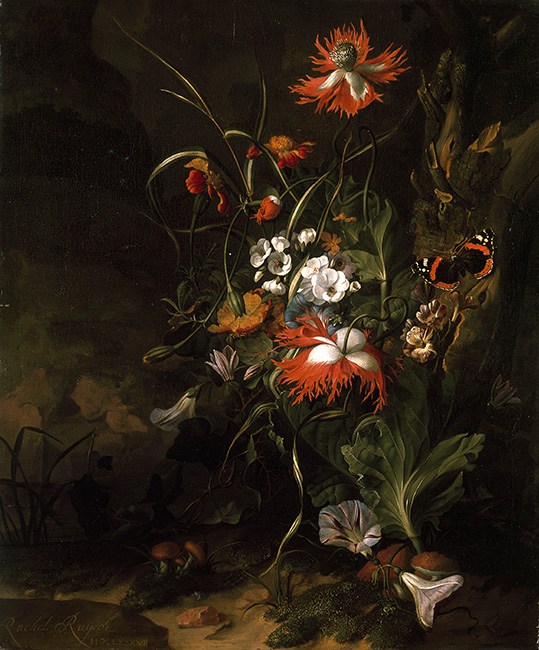
A 'Forest Floor' Still Life of Flowers, Rachel Ruysch, 1687, oil on canvas © Ashmolean Museum
Women artists also found their niche in botanical art and floral paintings from this time. The wonderful ‘forest floor’ painting by Rachel Ruysch shows poppies with frayed petals, symbolising the fleetingness and frailty of life.
Following on from the Renaissance and Dutch and Flemish Masters, the beauty and minutiae of plants and flowers continued to consume artists and illuminati across the world. India's Mughal Emperor Jahangir (reigned 1605–1627), employed Mansur Naqqash (Ustad Mansur, d.1624) as his botanical and natural history artist. In France, Pierre-Joseph Redouté (1759–1840), along with his brothers and contemporaries, painted and engraved sumptuous roses and garden flowers for rich patrons – notably Empress Joséphine Bonaparte (1763–1814) – and Marie Antoinette.
Redouté’s tradition of using vellum as his choice support was carried into the 20th century by Rory McEwen, perhaps the most celebrated Scottish botanical artist of our times. Rose ‘Agnes’, which features in the ‘In Bloom’ exhibition, is a sumptuous example of McEwen’s oeuvre, bringing together the technical virtuosity of past masters with the perceptiveness of modern artistic practice.
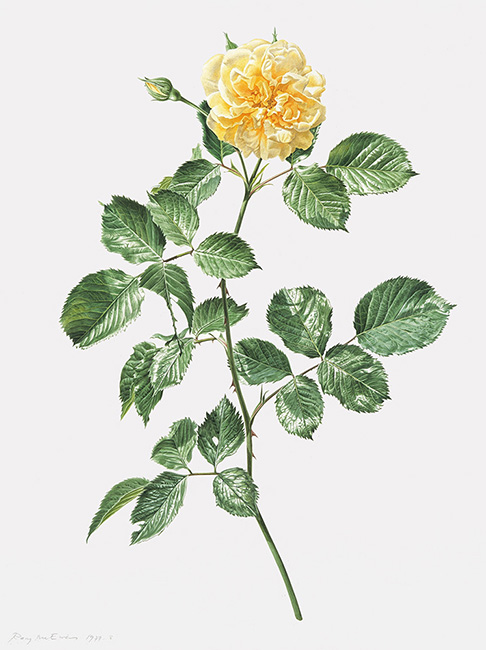
Study of a Yellow Rose, Rory McEwen, 1977, watercolour on vellum © Rory McEwen, courtesy of the Shirley Sherwood Collection
The polymath and art-historian John Ruskin, a staunch supporter of the pre-Raphaelite brotherhood, celebrated the power of art as a mirror of nature. As a teacher, he advocated the close study of its subjects. His delicate study of a wild or dog rose (Rosa canina), one of Britain’s few native roses, bears witness to this philosophy, marrying attention to detail with the agile application of a subtle palette.

Study of Wild Rose, John Ruskin, 1871, watercolour, graphite & bodywash on wove paper © Ashmolean Museum
Trade and knowledge of plants played a crucial role in the emergence of Britain as a global imperial power.
From the early participation of the East India Company in the spice and sugar trades, to the control of cotton, tea, and rubber production, Britain’s growth and prosperity relied on the extraction and commercialisation of natural resources of her colonies.
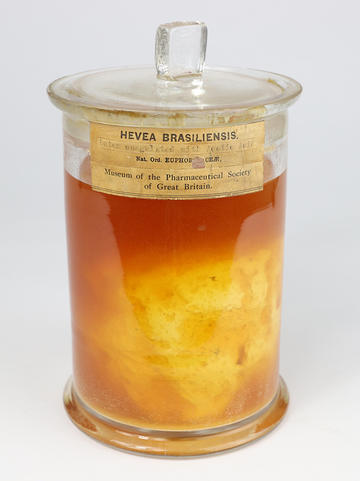
Rubber latex (Hevea brasilensis), Brazil, 19th century, glass, latex, acetic acid. The Board of Trustees of the Royal Botanic Gardens, Kew, 99478
The Royal Botanical Gardens at Kew were established to support this plant-driven economy. Through a network of botanists and gardens disseminated across colonial outposts, Kew collected and documented a large number of the world’s plants. The purpose was not only scientific, but also to identify plants with the biggest economic promise.

The Great Palm House at Kew Gardens, c.1850, hand-coloured engraving on paper. The Board of Trustees of the Royal Botanic Gardens, Kew, 2147
This quest encouraged the development of monocultures, which displaced local biodiversity and impacted indigenous ways of living.
Increased knowledge of the world’s flora and innovative methods for safer transportation of specimens made a new wave of exotic ornamental plants available from the 1800s onwards.
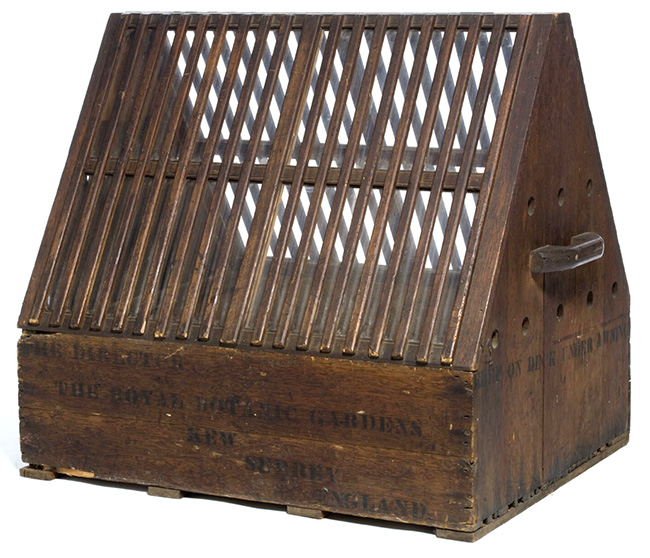
A Wardian case, c. 1870, wood and glass © The Board of Trustees of the Royal Gardens, Kew 99478
In Victorian Britain, the craze for ferns, rhododendrons, and orchids reached larger segments of society, sustained by imperial circuits and global procurers. Local nurseries and garden centres contributed to the process, with some even doubling up as childcare centres to support working-class women.
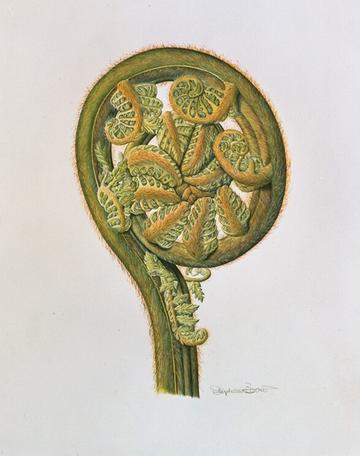
Australian Tree Fern (Balantium antarcticum), Stephanie Berni, 2004, watercolour on pencil on paper © Shirley Sherwood Collection

Rhododendron thomsonii, Walter Hood Fitch, 1849-1851, hand-coloured lithograph © The Board of Trustees of the Royal Gardens, Kew
The legacies of centuries of plant collecting and consumption are far-reaching. They range from the ecological consequences of overexploitation of natural resources, to the cultural loss derived from the collapse of local ecosystems. Their impact continues to be deeply felt around the world, particularly in the Global South.
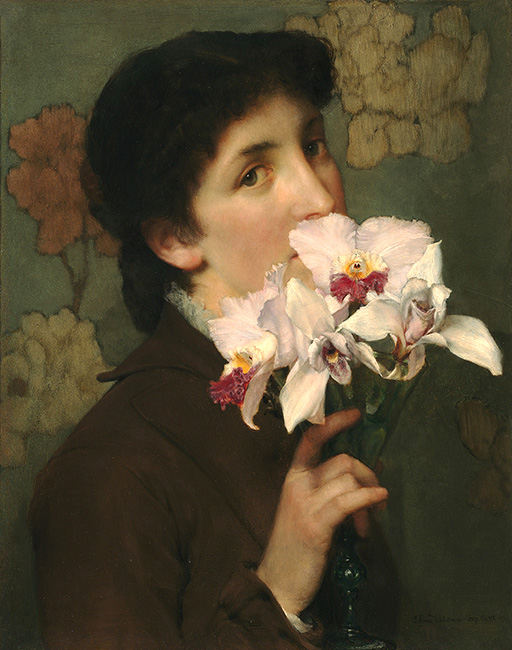
Orchids, Sir Lawrence Alma Tadema, 1879, oil on panel © Private Collection, USA. Photo courtesy of the Richard Green Gallery, London
Today we stand at the tipping point of environmental change, with an estimated 45 per cent of flowering plants now threatened with extinction. As we reflect on this fact and how we arrived here, the worlds of art and science offer, once again, inspiration and solutions.
Plants and flowers are central to the work of contemporary artists exhibited in the In Bloom exhibition. They include Anahita Norouzi, Işık Güner, Alexandra Daisy Ginsberg, Justine Smith and Kate Friend.


Left: Detail of 'What's in a name' installation featuring black iris mutants by Anahita Norouzi, 2022, glass & brass. Right: Large flower C-type colour prints named after famous people by Kate Friend, 2024. In Bloom gallery 3 displays
Exploring the roots of this imbalance and proposing empathetic models of interaction, these artworks also suggest new ways to rethink our relationship with the natural world.

Detail of Justine Smith’s ‘Specimen Florae Brittaniae’ installation, 2023-24, with £50 bank notes from the In Bloom exhibition
Paper has always been a primary material in the work of Justine Smith, a British artist based in London. Her current work is concerned with the concept of money as a conduit of power, the value systems with which we surround it and how it touches all aspects of our lives. Her works in the ‘wild flower/weed sculptures’ project, from which the artwork above is drawn, extend the commentary to social-political, ecological and environmental issues. She makes poignant and critical interventions through the ideas and concepts interestingly shared by the worlds of plants and paper currency.
The University of Oxford continues to be a hub for pathbreaking multi-disciplinary research, contributing to the wider body of knowledge that underpins how plants continue to change our world. Featured in the In Bloom exhibition are five ‘Changemakers’, each photographed by artist-photographer Fran Monks, with an object of their choice, which helps to tell their story.
‘Oxford’s Changemakers’ is Monks’s special commission for ‘In Bloom’. An environmentalist before training as a photographer in the USA, Monks brings a unique appreciation of the work of the ‘Changemakers’ to her portraits.
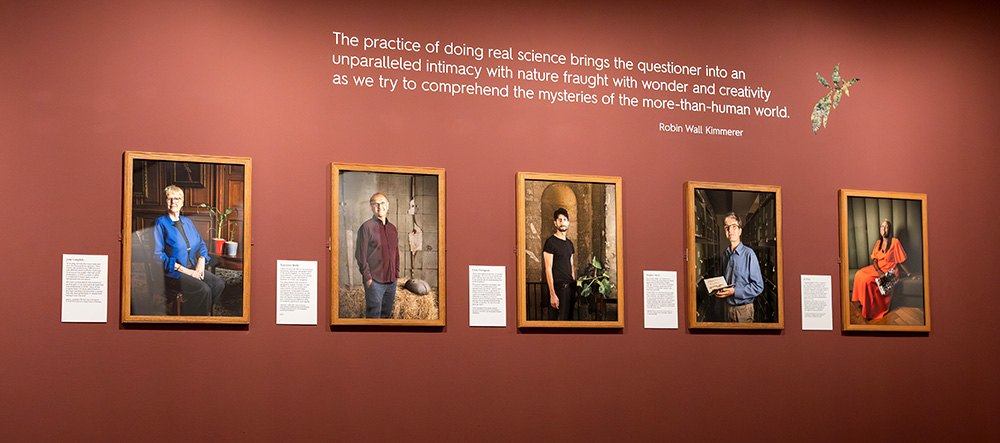
Wall display of 'Changemakers' in the In Bloom exhibition's gallery 3