

SISTERS, BROTHERS, OTHERS: NATIONALITY AND 20TH-CENTURY CHINESE ART

Open 11 Jul 2026 – 7 Mar 2027
Gallery 11
Admission is FREE
Most citizens of the People’s Republic of China are Han, an ethnicity often translated as ‘Chinese.’ Officially, however, 56 different ‘brother and sister nationalities’ make up the country.
The Sisters, Brothers, Others exhibition showcases how both Han and non-Han artists in the People's Republic of China have approached notions of 'self' and 'other' in their depictions of nationality and ethnicity.
Through artworks and objects ranging from political propaganda posters to intimate self-portraits, the show explores questions of identity and the relationship between artistic and political representation.

Small Mirror, A Ge, 1991, multi-block colour woodcut © the artist / Ashmolean Museum

Portrait of Yongyu, Huang Yongyu, 1948, ink on paper © Ashmolean Museum
After the Manchu Qing dynasty fell in 1912, China transformed from an empire representing the power of an emperor into a state representing a nation. How could the diverse population of the former empire be united into a single national identity?
The Communist Party’s solution was a political system that was supposed to protect minority nationalities with a degree of cultural, linguistic, and territorial autonomy under the umbrella of a majority-Han, Chinese nation-state. This system shapes many of the works in this exhibition but it also displays a greater variety of ways of thinking about the relationship between national identity and ethnic diversity in 20th century China.
The questioning spirit of the exhibition is demonstrated by its inclusion of a wide variety of artists, from Tibetan and Yi woodblock printers A Ge and Qijia Dawa, to Han, Mongolian, and Manchu ink painters Pang Xunqin, Hu Peiheng, and Pu Quan (cousin to the last emperor Pu Yi).
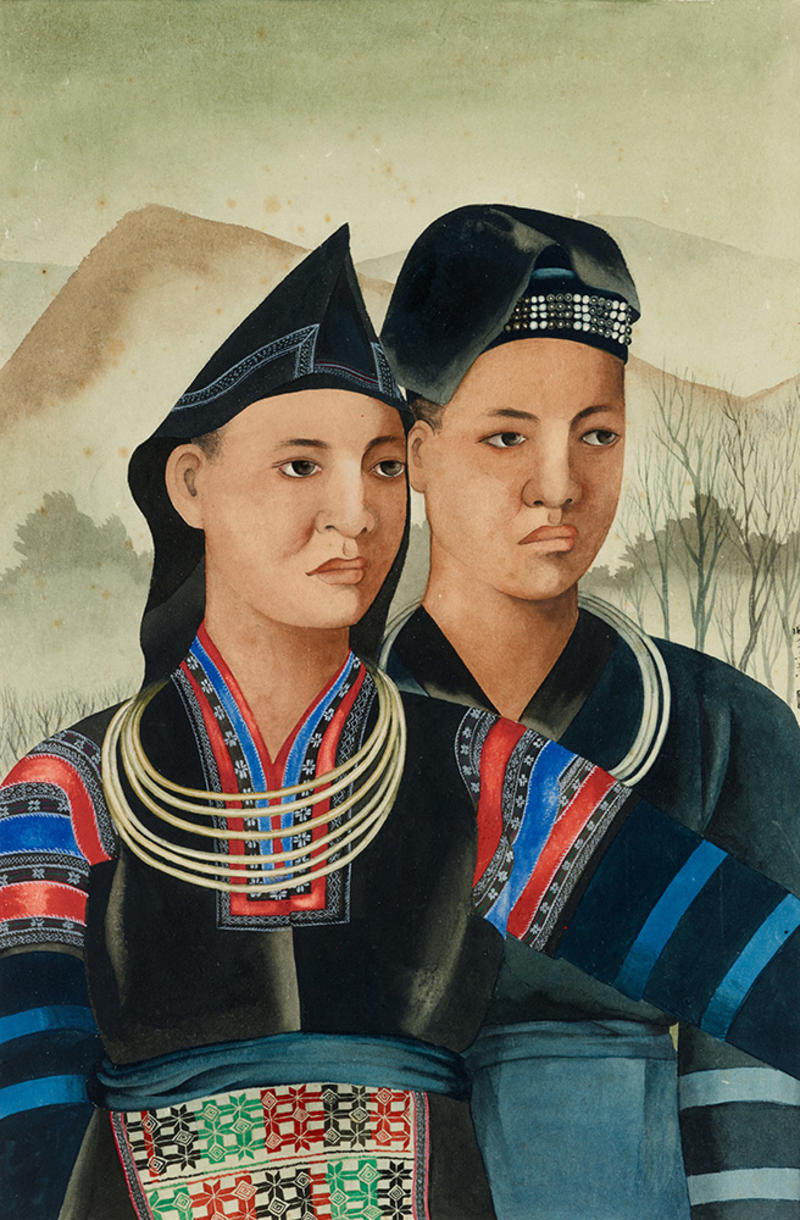
Two female Miao figures, Pang Xunqin, 1944/5, ink & colour on paper © Ashmolean Museum

Landscape with river and mountains, Hu Peiheng, 20th century, ink & colour on paper © Ashmolean Museum

Ancient Temple on the Plateau, Qijia Dawa, 1981, woodcut print, oil-based ink on paper © Ashmolean Museum

Matchbox depicting Uyghur barefoot doctor, 1975 © Ashmolean Museum
Similarly, the works on display reflect a wide range of media, including lithographic and woodblock prints, oil and ink painting, posters and paper-cuts, matchboxes, and books.

