
GWEN JOHN'S QUIET GENIUS
Born in 1876 in Haverfordwest, Wales, Gwen John studied at the Slade School of Art in the 1890s alongside her brother Augustus. He famously said that he would one day be known as ‘the brother of Gwen John,’ and his words have come true: while Augustus was much more famous during the siblings’ lifetime, his star has since waned while Gwen’s has only risen.
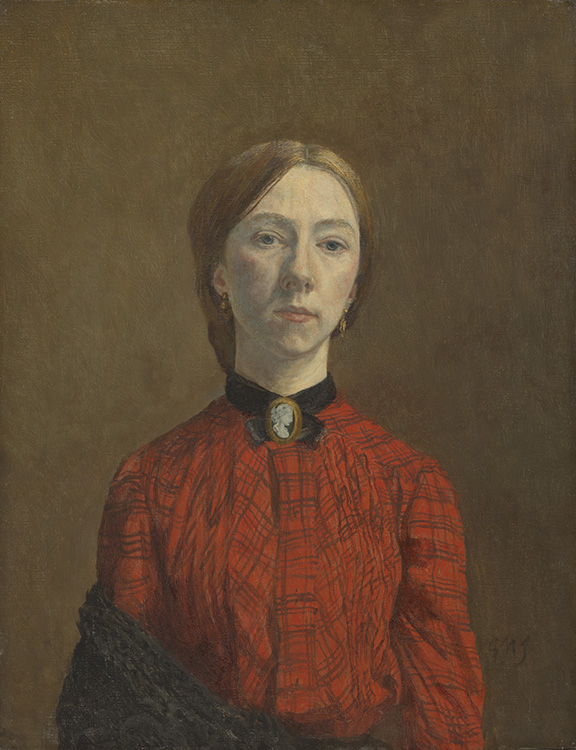
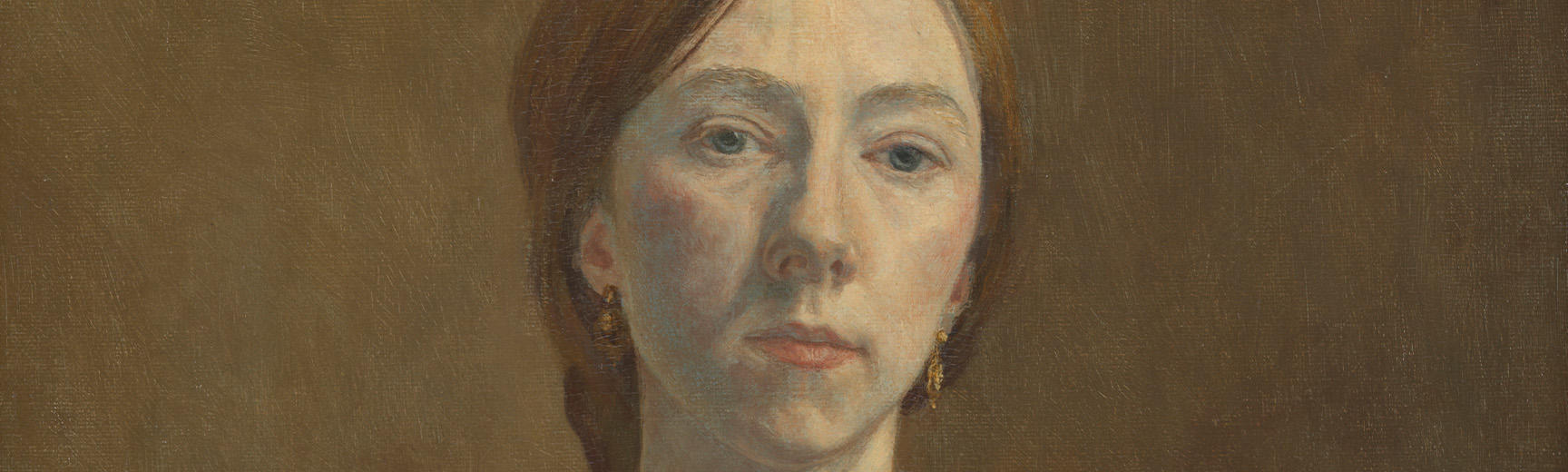
Self portrait, Gwen John, 1902, oil on canvas © Tate Images
At the Slade, John was taught by Professor Henry Tonks to prioritise careful draughtsmanship and drawing from life. She studied alongside a dynamic group of young artists who would go on to varied careers, including William Orpen, Ambrose McEvoy, Edna Clarke Hall, and her brother.
After leaving school, John set out with her friend Dorothy (also called Dorelia) McNeill to walk from England to Rome! They made it as far as Toulouse, sleeping under hay bales in rural France or drawing portraits in exchange for their room and board in inns. McNeill would eventually form a lifelong relationship with John’s brother Augustus and return to England to live with him, but John stayed in France for the rest of her life.
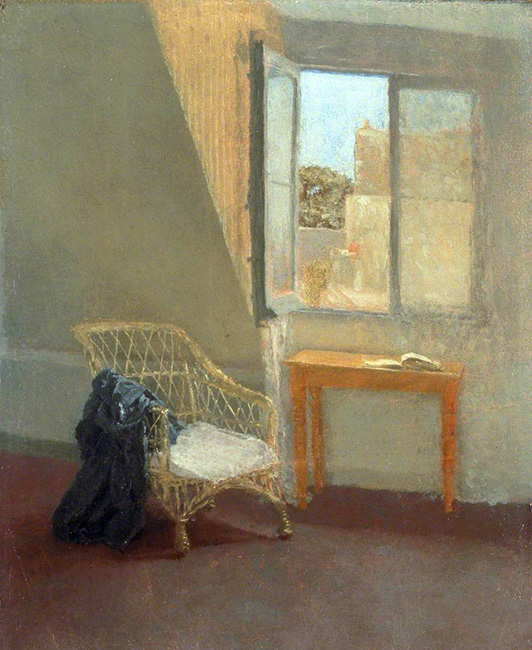
A Corner of the Artist’s Room in Paris, Gwen John, 1907-1909, oil on canvas © National Museum Wales
She settled in Paris, in an attic bedsit on the left bank which she drew and painted often. These works have become emblematic of her contemporary Virginia Woolf’s essay ‘A Room of One’s Own’ – they capture an idyll of female independent living at a time when it was rarely accessible. She worked as an artist’s model to support herself alongside making her own art. She modelled for the sculptor Auguste Rodin, with whom she became infatuated and would have a long romantic relationship. She never married, nor did she seem to have any wish to.
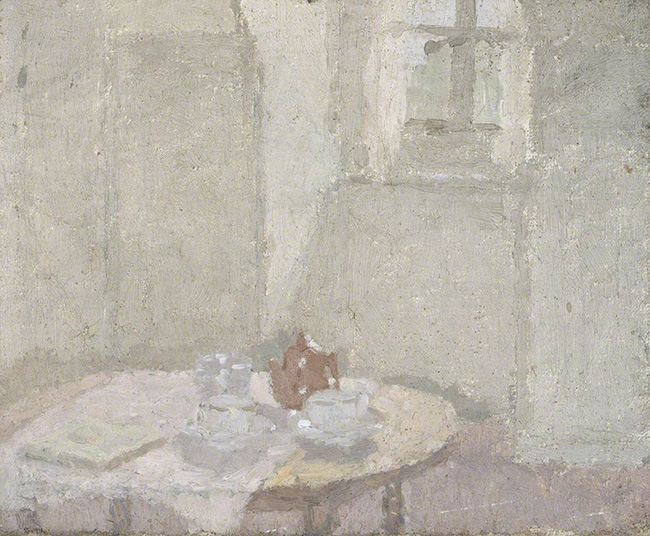
The Little Interior, Gwen John, 1920-1925, oil on canvas © National Museum Wales
Eventually, John moved to the village of Meudon outside Paris, where she lived for the rest of her life. She converted to Catholicism around 1913 and attended her local church regularly. Her faith inflected much of her later work, both in ethos and subject matter.
Throughout her life, she maintained a close friendship and steady correspondence with her friend from the Slade, Ursula Tyrwhitt. Their letters are a wonderful source of insight into John’s preoccupations over the decades, both personal and professional. She died in France in 1939.
John’s paintings almost always depict solitary women. Some of her sitters have been identified as specific friends or models, but in general the paintings retain a sense of anonymity and stillness.
John used a sensitively arranged tonal palette, which shows the influence of James McNeill Whistler, who was briefly her teacher at the Academie Carmen in Paris.
She was deeply interested in colour theory, a relatively new set of scientific ideas about the ways colours interact in our vision. Her notes trace her engagement with these ideas and her methodical planning of the colours she used on her canvases.
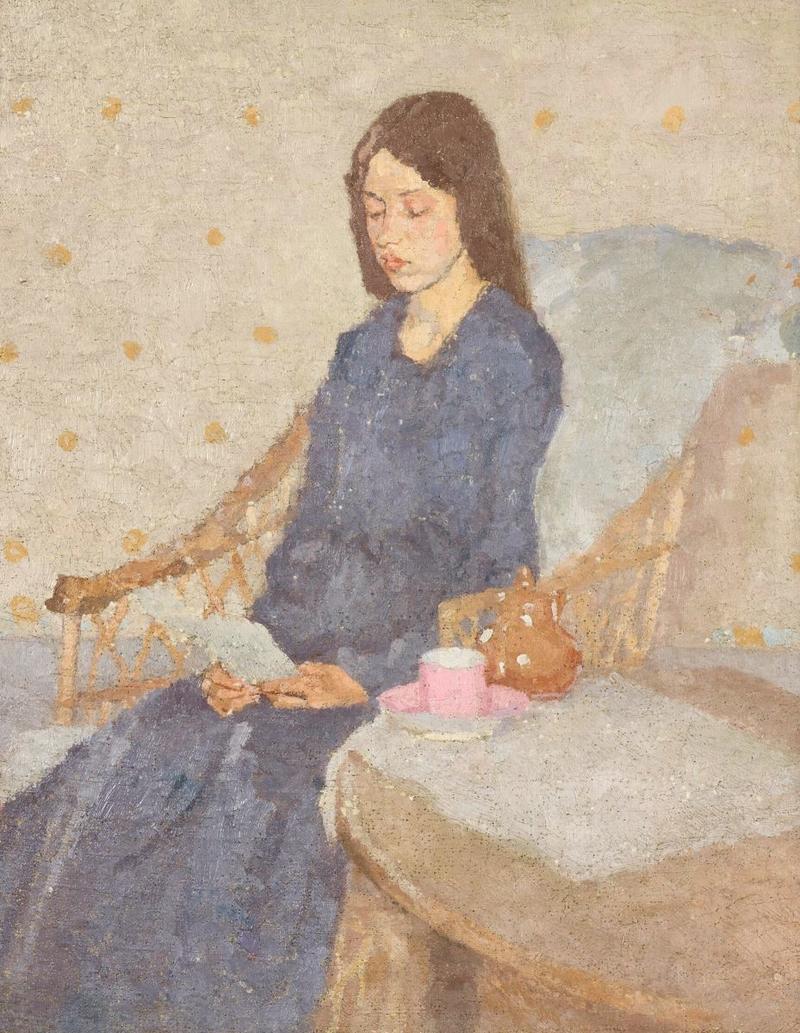
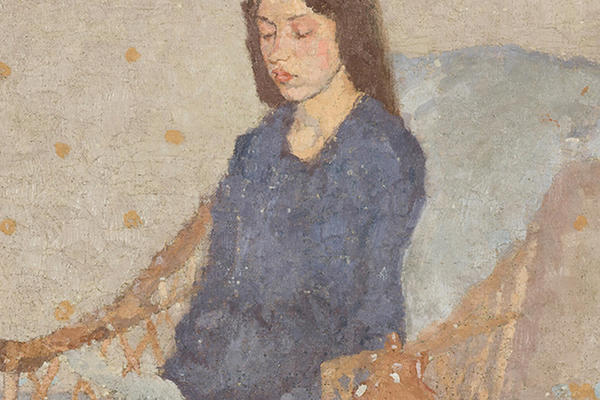
The Convalescent, Gwen John, 1919-1926, oil on canvas © Ashmolean Museum
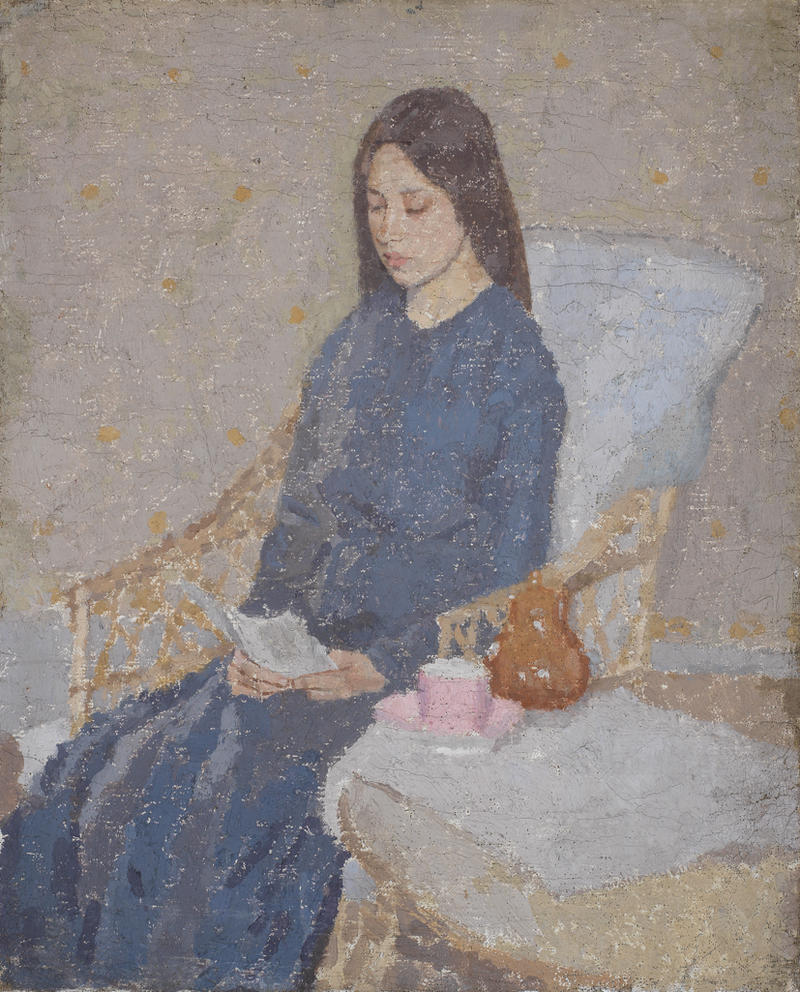
The Convalescent, Gwen John, 1923-1924, oil on canvas © The Fitzwilliam Museum
The Ashmolean’s painting by John is titled The Convalescent. It is part of a series of works of the same subject: a young woman sitting in a chair looking down at a book or paper in her lap. John’s iterative approach to working meant that she often revisited the same subject again and again, building up series of compositions that subtly shift over time.
John’s paintings are characterised by a chalky texture that absorbs light rather than reflecting it. They have a powerful, quiet stillness to them. They refuse easy reading and reward slow, careful looking.
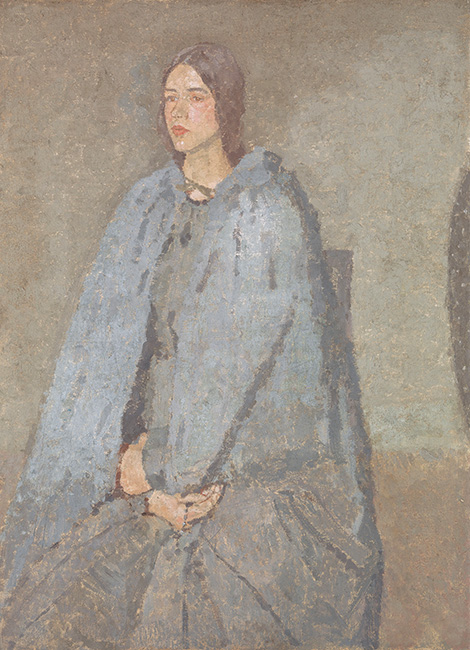
The Pilgrim, Gwen John, c. 1920, oil on canvas © Yale Center for British Art
Unlike many of her contemporaries, John felt that her drawings and works on paper were as important as her paintings. In part, this feeling is grounded in her education at the Slade which privileged drawing over painting. But it also reflects her personal preference for working with paper and for the immediacy of drawing from life.
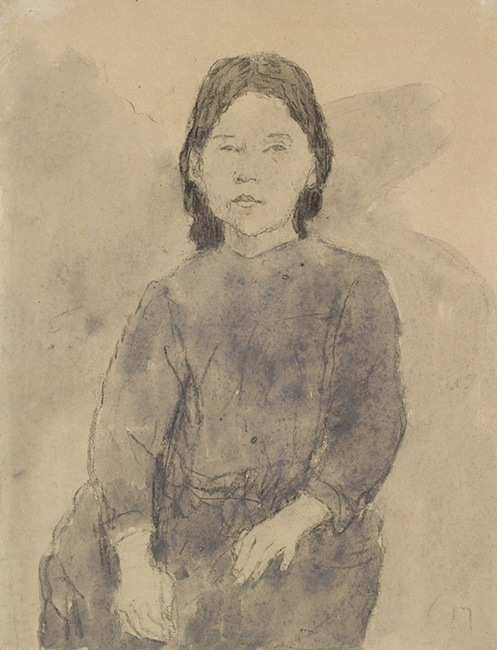
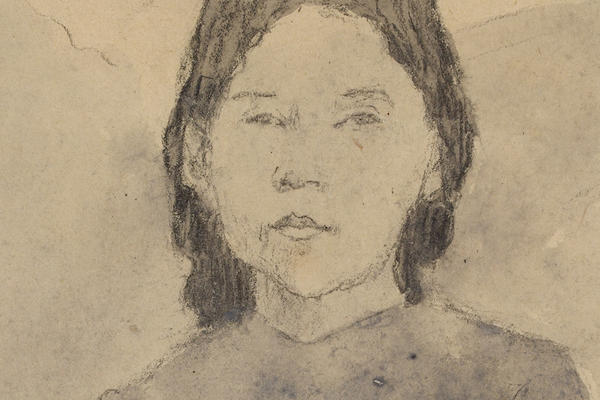
Seated Girl (probably Marie Hamonet), Gwen John, c. 1918-1919, charcoal, grey wash & bodycolour on paper © Ashmolean Museum
John drew more than she painted in the late 1910s, writing to her patron John Quinn in July 1920, ‘I have been doing nothing but drawings for a long time.’ In a letter to her friend Ursula Tyrwhitt in October 1918, after returning from her first summer in Brittany, she wrote ‘My last drawings look much better if they are seen a lot together. It is difficult to know why.’ Perhaps it was their large number and rapid execution that made her feel that their power was best felt when viewed as a group.
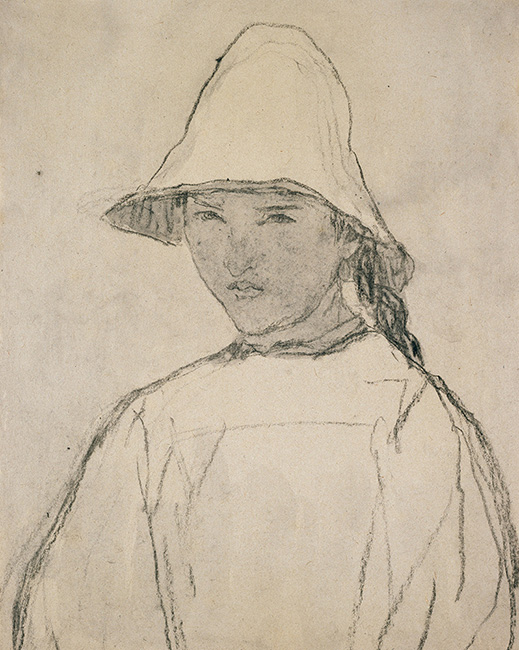
Girl in a Hat (Odette Litalien), Gwen John, c. 1918-1919, charcoal & grey wash on paper © Ashmolean Museum
She showed a selection of drawings at the Salon d’Automne in 1919, in the first exhibition held by the progressive Parisian annual salon after the First World War. These were most likely drawings of Breton children, which may have included some of the four drawings from this series in the Ashmolean’s collection.
It was an unusual choice to show drawings rather than paintings at the Salon, but John’s work was consistently well-reviewed.
John also drew sketches regularly in church, for which she was chastised but never deterred. Her drawings and watercolours of the congregation in Meudon range in size from tiny thumbnails to full sketchbook pages. At times, they can look like almost completely abstracted shapes and colours. John was particularly fascinated by the unusual shapes present in Catholic spaces and iconography, like the striking habits worn by the nuns in her community.
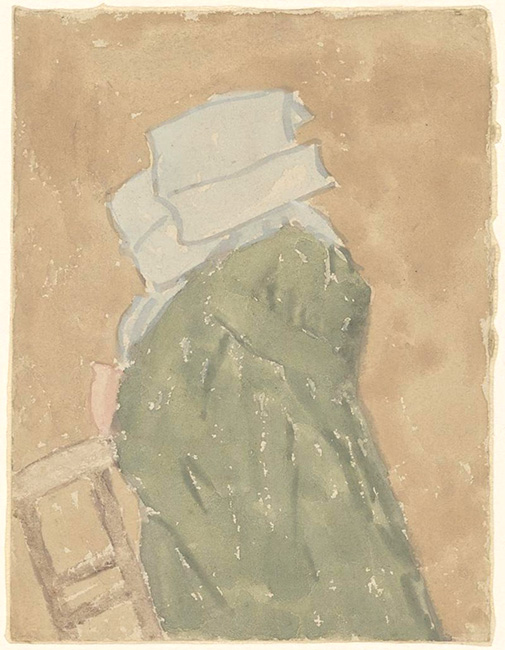
Nun in church, Gwen John, after 1913, watercolour on paper © National Museum Wales
The Ashmolean holds a collection of six drawings by John, which have been the subject of new research as part of the 20th-Century British Drawings Project funded by the Elizabeth Cayzer Charitable Trust.
Gwen John’s life and work have lent themselves to mythologising.
John was protective over her lifestyle and artistic practice in a way few women were able to be in the early 20th century. She has been perceived, partly because of the narrative peddled by her brother Augustus after her death, as an impoverished recluse rather than a successful working artist who chose to protect her independence. His tender drawing of her, made in blue chalk when they were students together at the Slade, captures that sense of quiet solitude that Augustus would make central to her legacy.
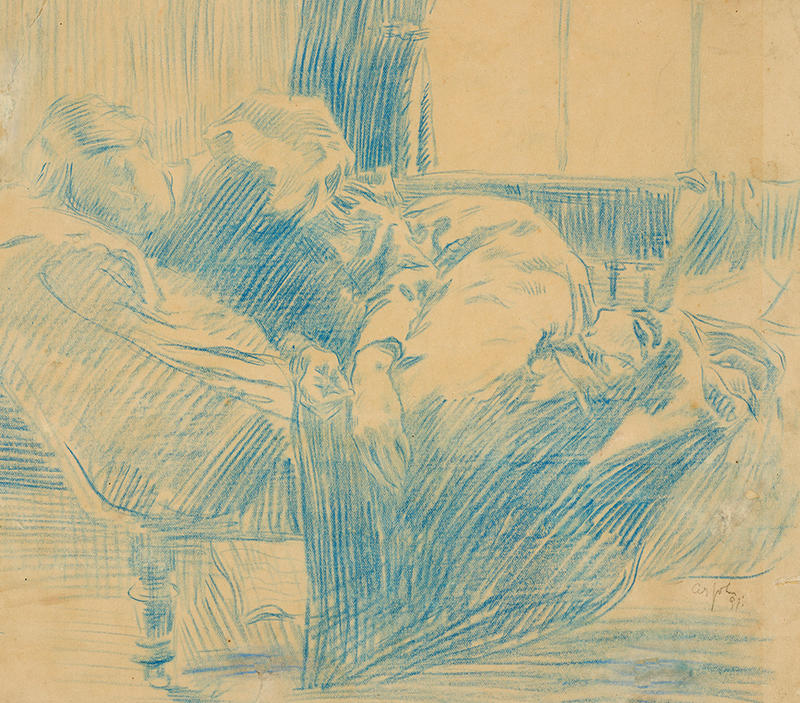
Gwen John reclining, Augustus John, 1897, blue chalk with some graphite on paper © Ashmolean Museum
John was uninterested in fame and fortune, but she was not uninterested in success. She exhibited regularly throughout her life and secured a stable income via her patron, Quinn, who paid her an annuity in return for everything she produced.
To her brother, whose cultivation of fame was perhaps his chief priority, John’s choice to leave her family and network in England to make quiet little works in France seemed bizarre. But it is her work that has proved to be truly novel, and truly lasting in the history of modern art and aesthetics.
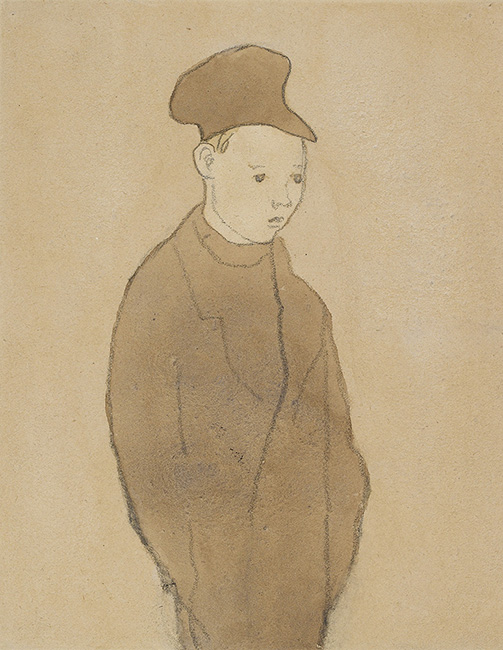
Boy with Blank Expression, Gwen John, 1928, charcoal & gouache with white chalk on paper © Ashmolean Museum
In the past decade, John’s legacy has had a much-needed reassessment. Through the work of scholars and curators like Alicia Foster and Lucy Wood, she has been met on her own terms as a deeply serious artist with a clear sense of purpose. She does not fit neatly into an artistic school or movement, but that does not mean she had no friends or artistic influences. She was simply an original.