

APHRODITE - press release

Updated 2 September 2026

The civilisations that first created Aphrodite disappeared long ago. Her image never did.
There are few figures in human history, fewer women still, whose fame has lasted for 5,000 years. Aphrodite's story stretches from ancient Cyprus to the present day. Immortalised by Botticelli, who gave her one of the most recognisable faces in the history of art, and endlessly reinterpreted through the ages, Aphrodite and her Roman counterpart, Venus, remain defining symbols of beauty and desire in Western culture.
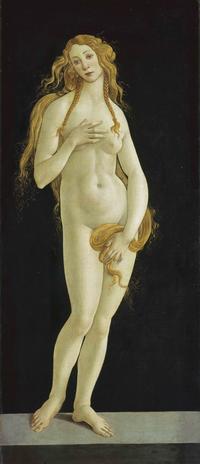
The Ashmolean’s autumn exhibition explores one of the ancient world's most enduring cultural icons. Bringing together archaeology, sculpture, painting, contemporary art and fashion, The Making of a Goddess traces Aphrodite’s journey and transformations from her earliest origins in the eastern Mediterranean, through the ancient Greek and Roman worlds, via Renaissance Europe, to our continuing fascination with her today. Highlights include iconic ancient sculptures such as the Crouching Aphrodite (c. 199 CE) from the Royal Collection and a Capitoline Venus (c. 160 CE) on loan from the Louvre; Botticelli's Venus (c. 1490) from the Gemäldegalerie, Berlin; modern works by Yves Klein and Michelangelo Pistoletto; and Jonathan Anderson's Loewe dress, worn by Beyoncé.
Aphrodite’s story begins in Cyprus, the island where she emerged as a goddess and where visitors and immigrants from the Greek Aegean first encountered her. From these origins grew the myths that made Aphrodite famous, told and retold by the great writers of the ancient world, including Homer, Hesiod, Euripides, Ovid and Virgil. They recounted her birth from the sea, her role in the Judgement of Paris that led to the Trojan War, her love affairs with the beautiful Adonis, and with Anchises, the father of her son Aeneas, the Trojan War hero whose descendants founded Rome. The exhibition explores these myths with ancient vases, sculpture, jewellery, and other spectacular antiquities like the Louvre’s mosaic from Tunisia (200–250 CE) showing Aphrodite sailing on a barge.
The exhibition goes on to explore the cult of the goddess in ancient Cyprus and how she evolved from a much older tradition of female deities worshipped across the eastern Mediterranean, including Astarte and Ishtar. This evolution followed centuries of cultural exchange linking Cyprus with the Near East, Egypt and the Greek world. Here visitors will see the earliest known representation of Aphrodite – a unique copper alloy figurine from the Ashmolean’s collection dating to around 1200 BCE – one of the oldest objects in the exhibition. A recreation of an Aphrodite sanctuary using exceptional loans from Cyprus and major international collections will show how Aphrodite was worshipped as the all-powerful goddess across the island and the surprising ways she was depicted in ancient Cypriot art.
As Greek influence spread across the Mediterranean and Rome rose to power, Aphrodite was transformed into Venus, becoming an important Roman deity and a symbol of imperial identity. Here, the exhibition follows the creation of one of the most influential image traditions in art history – the female nude. At its centre is one of the best-preserved marble sculptures known widely as the Capitoline Venus, a celebrated Roman version of the Knidian Aphrodite, the revolutionary 4th-century BCE sculpture by Praxiteles. Widely regarded as the first monumental female nude in ancient art, the statue transformed how the female body was represented throughout antiquity. Copied hundreds of times across the Roman Empire, its image survived long after the original disappeared.
Rediscovered during the Renaissance, such ancient sculptures of Venus inspired generations of artists, collectors and rulers. Most famous among them was the Venus de' Medici, unearthed in a vineyard in Rome in the 1530s. It rapidly became a sensation and exerted an extraordinary hold on Western imagination for centuries thereafter. The exhibition includes the first full-scale bronze cast of the original Venus de' Medici, commissioned for Blenheim Palace by the 1st Duke of Marlborough in 1711.
The exhibition closes with modern and contemporary visions of Aphrodite, whose image has long served as a focus for society's changing ideas about women, femininity and female beauty. Highlights include Michelangelo Pistoletto's Venus of the Rags (1967, 1974), which places a garden centre statue before a heap of discarded clothing; and Yves Klein's signature blue reinterpretation of the Venus de' Medici (1982). The goddess also appears in contemporary fashion through Jonathan Anderson's Loewe dress redesigned for Beyoncé's 2023 Renaissance world tour, which reimagined Venus for a 21st-century audience.
The exhibition is curated by Dr Anja Ulbrich, a leading expert on Cypriot archaeology and female deities of Cyprus. She says: ‘I first became fascinated by Cyprus while studying archaeology as a student, and I have spent much of my career exploring the island's ancient culture, religious traditions and Mediterranean connections. Aphrodite has been at the centre of my work. This exhibition brings together antiquities and European art, which I have studied and admired for many years, to tell the remarkable story of how a goddess worshipped in ancient Cyprus became one of the most enduring and recognisable figures in human history.’
Dr Xa Sturgis CBE, Director of the Ashmolean, says: ‘We are deeply grateful to the many institutions and colleagues who have helped make this exhibition possible, particularly the Department of Antiquities, Cyprus, whose support has been invaluable. Bringing together exceptional loans from across Europe and North America alongside objects from our own collections, the exhibition traces more than 5,000 years of history, offering an exciting perspective on Aphrodite.’
ENDS
PRESS IMAGES
Images are for editorial use only and are supplied under the terms found in the accompanying Captions and Credits document. Please download images, captions and credits at: https://go.glam.ox.ac.uk/Aphrodite.
Images above:
Crouching Aphrodite
Roman, after Hellenistic original, 2nd century CE
Marble, 125 x 53 x 65 cm
The Royal Collection/ HM King Charles III.
© Royal Collection Enterprises Limited 2026 | Royal Collection Trust. Photograph: British Museum
Sandro Botticelli (1445–1510) and workshop
Venus, c. 1490
Tempera on canvas, 187 x 98 cm
Staatliche Museen zu Berlin, Gemäldegalerie. Photograph: Jörg P. Anders.
CONTACT DETAILS
Claire Parris, Strategic Communications Manager, University of Oxford Museums and Gardens
Sarah Holland, Press Assistant, University of Oxford Museums and Gardens
NOTES TO EDITORS
Exhibition: Aphrodite: The Making of a Goddess
Dates: 8 October 2026–11 April 2027
Venue: The John Sainsbury Exhibition Galleries, Ashmolean Museum, Beaumont Street, Oxford OX1 2PH
Admission: £8–£18.10
Tickets: Advanced booking recommended: Upcoming Exhibitions.
Catalogue: The exhibition is accompanied by a fully illustrated catalogue: £25, available at the Museum or online.
Press View: Monday 5 October 2026, 11:00–14:00
Lead supporter:
The A.G. Leventis Foundation
The exhibition is supported by:
The Huo Family Foundation; Kaplanis Charitable Trust; Patrons of the Ashmolean; The Michael Marks Charitable Trust; The High Commission of the Republic of Cyprus in the UK; The Panayotis & Effie Michelis Foundation; The Anson Charitable Trust.
The exhibition is curated by:
Dr Anja Ulbrich, A.G. Leventis Curator of Cypriot Antiquities, Ashmolean Museum.
Co-curation by:
Dr Peter A. Thompson, Assistant Curator of Classical Archaeology, Ashmolean Museum
Liam McNamara, Keeper of the Department of Antiquities, Ashmolean Museum
Dr Jennifer Sliwka, Director of the Picture Gallery of the Kunsthistorisches Museum, Vienna
About the Ashmolean
The Ashmolean is the University of Oxford’s museum of art and archaeology, founded in 1683. Our world-famous collections range from ancient Egypt to contemporary art, telling human stories across cultures and across time.
Admission: Free
Open: Daily, 10:00-17:00

