

TAHARQA'S SHRINE ILLUMINATED
4 November 2026
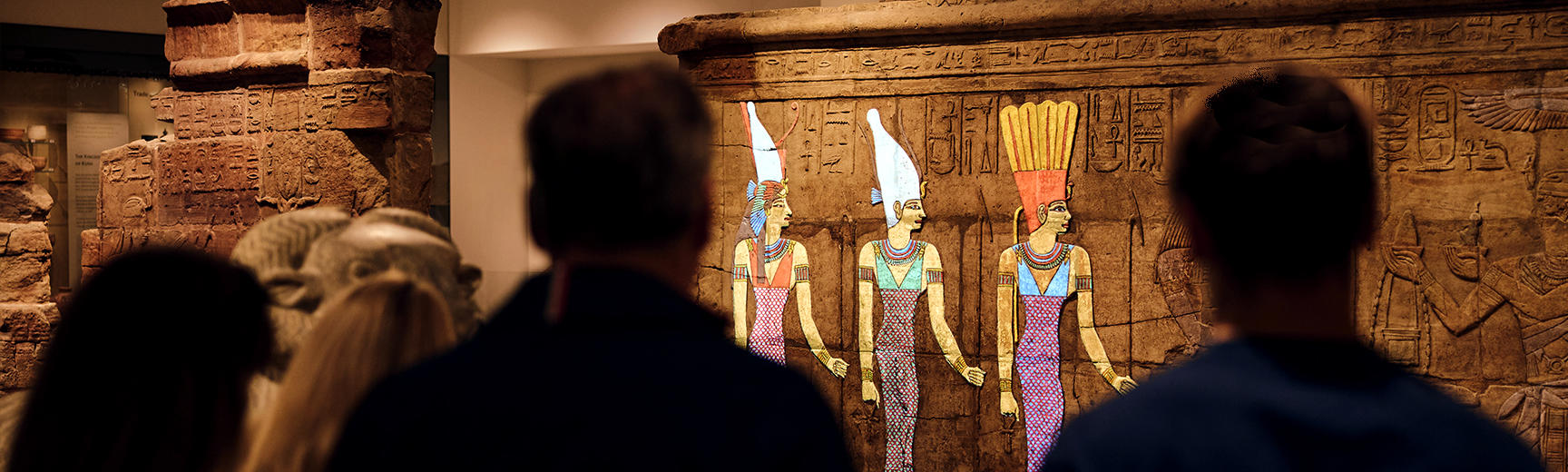
The Ashmolean is to transform the celebrated ancient monument – the Shrine of King Taharqa – with a colourful light projection that will reveal for the very first time how this unique 2,700-year-old building would have looked in its original splendour.
The Shrine of King Taharqa, the only free-standing pharaonic building in Britain, is the centrepiece of the Ashmolean’s Ancient Egypt and Sudan galleries. This new installation marks the 90th anniversary of the Shrine's arrival at the Ashmolean in 1936.
From 13 November 2026, visitors to the Museum will be able to experience a reconstruction of its original painted decoration, with brilliant blues, reds, yellows, and other colours projected onto the sandstone walls.
Made possible through the generous support of Lord and Lady Lupton, the new installation combines archaeological and scientific research with digital technology to offer a fresh perspective on one of the Ashmolean's most remarkable ancient monuments.
Built between 690–654 BCE by King Taharqa, who ruled both Egypt and Kush (in present-day Sudan), the Shrine originally stood within the great temple of the god Amun-Re at Kawa in northern Sudan. Its intricately carved walls depict the king making offerings to the gods, expressing both his royal authority and his devotion to the divine.
Although the Shrine's sandstone walls appear largely uncoloured today, they were once covered in elaborate painted decoration. Scientific investigations, including microscopic analysis of surviving pigments and specialist photographic techniques, have unveiled traces of the original colours. This has allowed researchers to reconstruct how the Shrine appeared over 2,700 years ago and, in so doing, reveal intriguing new insights into the religious beliefs and artistic choices of the Shrine's creators.
One of the most exciting discoveries is evidence of Egyptian blue, an ancient pigment detected using infrared photography. This particular colour appears to have been reserved for specific divine figures and imagery.
The new visitor experience uses digital projection to shine the colours onto the Shrine's carved surface, allowing viewers to watch its ancient decoration emerge before their eyes.
Two specially created films explore the monument's remarkable history and meaning. The first follows the Shrine's journey from its construction in ancient Sudan, through centuries of burial until its excavation in the 1930s, to the scientific discoveries that have made its colourful reconstruction possible. The second brings the carved scenes into focus, introducing King Taharqa and the gods and goddesses represented on the walls, while revealing the significance of their elaborate costumes, symbols, and offerings.
Liam McNamara, Keeper of Antiquities and Lisa and Bernard Selz Curator of Ancient Egypt and Sudan at the Ashmolean Museum, says: ‘This exceptional monument offers a fascinating insight into the art and archaeology of ancient Sudan. The new projection – and the scientific research behind it – will allow visitors to appreciate and understand the Shrine’s original painted decoration like never before.’
Dr Xa Sturgis CBE, Director of the Ashmolean, says: ‘Many of the stone monuments and statues of the ancient world in our museums were once brightly coloured. We are enormously grateful to Lord and Lady Lupton for their generous support in helping us reveal the Shrine of Taharqa in a completely new light.’
The Lord Lupton CBE, Chair of the Board of Visitors of the Ashmolean Museum, says: ‘A trip to Egypt in 2022 inspired my interest in the vivid colours used millennia ago, preserved by the arid climate, and still visible today. I hope that this use of technology in the Ashmolean will similarly inspire our visitors, especially the young.’
The new installation will be free for all visitors to experience in the Ashmolean's Ancient Egypt and Sudan galleries from 13 November 2026.
ENDS
CONTACT DETAILS
Sarah Holland, Press Assistant, University of Oxford Museums and Gardens
sarah.holland@glam.ox.ac.uk / +44 (0)7714 435 868 or +44 (0)1865 278 285
PRESS IMAGES
Images for editorial use are available to download from Dropbox.
Banner image above: Shrine of Taharqa © Fisher Studios, 2026 – courtesy Ashmolean Museum, University of Oxford
NOTES TO EDITORS
The Shrine of Taharqa
Late Period, 25th Dynasty (Nubia and Egypt, 715–657 BCE)
Date of creation: 690–654 BCE
Sandstone 230 x 395 x 395 cm (h x w x d)
Ashmolean Museum, University of Oxford
Provenance:
Kawa, in northern Sudan, was excavated from 1930 onward by successive expeditions of the Oxford University Excavations in Nubia, directed and largely financed by the first Professor of Egyptology, Francis Llewellyn Griffith. The blocks of the Shrine were dismantled and packed into 150 wooden crates for transport to the National Museum in Khartoum. In recognition of its work, the Sudanese government generously ceded the building to the Oxford Expedition, and in 1936 Mrs Nora Griffith presented the monument to the Ashmolean in memory of her late husband’s services to Nubian archaeology.
About the Ashmolean Museum
The Ashmolean is the University of Oxford’s Museum of Art and Archaeology and the UK’s first public museum, founded in 1683. Our world-famous collections range from ancient Egypt to contemporary art, telling human stories across cultures and across time.
Admission: free
Open: daily, 10:00–17:00

