

CHRYSOS+ PROJECT
The field of study
CHRYSOS+ addresses a major and long-standing historical problem: the scale, mechanisms, and consequences of wealth transfer during the conquests of Alexander the Great and the wars of his immediate successors (334–281 BCE).
Alexander’s conquest of the Persian Empire, extending from the eastern Mediterranean to the borders of India, was followed by decades of near-continuous warfare among his successors. This period was characterised by unprecedented mobility and circulation of wealth across Asia and Europe. While posthumous portrayals of Alexander often emphasise cultural unification, ancient literary and cuneiform sources instead reveal widespread destruction, mass killings, and systematic looting.
Exceptionally dense coin hoards from the Levant further attest to prolonged instability and social disruption. Modern estimates suggest that the plunder of precious metals during the conquest and subsequent wars amounted to the equivalent of c. 4,680 tonnes of silver, or around one billion silver drachms, much of which was transferred westwards and converted into coinage. Understanding how this metal was mobilised, recycled, and monetised lies at the heart of the CHRYSOS+ project.
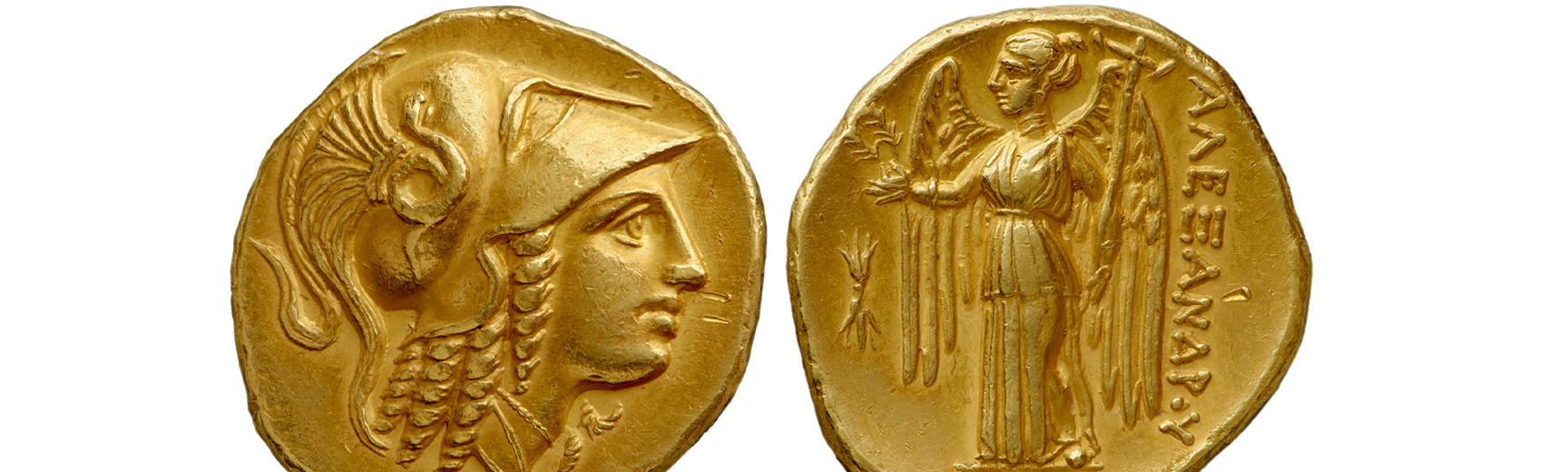
Coins are particularly well suited to provenance studies because their place and period of issue are often secure. The coinage issued in Alexander’s name was struck in exceptionally large quantities in gold, silver, and bronze across dozens of mints, but its scale and dispersion have long made comprehensive study impractical. Traditional die-studies – based on visual comparison of the matrices used to strike coins – were time-consuming and limited in scope.
About the research project
CHRYSOS+ is a 12-month pump-priming research initiative designed to establish the methodological and empirical foundations for a major interdisciplinary investigation into wealth transfer during the campaigns of Alexander and the wars of his successors (334–281 BCE).
The project focuses on the movement of precious metals from East to West, the recycling of bullion, and the manufacture of new artefacts from eastern gold, integrating numismatic, archaeological, metallurgical, and textual evidence. Its primary aim is to develop a robust proof of concept through the systematic study of the gold coinage issued in the name of Alexander the Great, preparing a competitive AHRC or ERC funding application in 2027.
The project builds on substantial preparatory work by the principal investigator, including the construction of a corpus of c. 17,000 gold coins. Gold coinage has been selected because it survives in quantities that allow near-complete coverage, while remaining sufficiently large to test methods intended for much larger corpora.
CHRYSOS+ will complete the standardisation and consolidation of this dataset and establish protocols for collaborative work and reuse.
A central component of the project is the integration of digital and scientific methods.
The gold corpus will be prepared for large-scale automated die-studies using DIEGEST, a high-performance automated system for die-studies currently under development at the Ashmolean Museum, overcomes these limitations and enables large-scale quantitative analysis. This capacity is central to the future project and underpins the pump-priming rationale of CHRYSOS+.
In parallel, CHRYSOS+ will consolidate existing metallurgical analyses of gold coinage and identify material suitable for future analytical campaigns in major museum collections, providing a reference framework for assessing provenance and recycling practices.
Beyond gold coinage, CHRYSOS+ will prepare the extension of this methodology to silver and bronze coinages, coin hoards, gold artefacts, and textual sources, including Greek, Aramaic, and cuneiform evidence. Its outcomes will include a completed gold corpus, a tested scalable workflow, and a clearly defined research design for the subsequent project.
Periods covered
350–280 BCE
Header image: Gold stater of Alexander the Great showing a winged Nike on the reverse c. 330–320 BC HCR9627
Project duration
July 2026-June 2027
Project funder
John Fell Fund, Oxford University Press
Project team
- Frédérique Duyrat (PI), Director of Collections, Keeper of the Heberden Coin Room
- Oliver Clarke, Research Assistant
- Roxanne Zaroff, Research Assistant
Research connections
DIEGEST PROJECT. Transforming the practice of die studies through computational die analysis and coinage quantification

