

MAJOR LOAN - press release
11 November 2026
A rare early painting by Sandro Botticelli (c. 1445–1510) goes on display at the Ashmolean in Oxford today, 11 November, more than 90 years after it was last exhibited at the Museum.
The Virgin and Child Enthroned, c. 1470, was acquired by the Klesch Collection earlier this year following a temporary export bar imposed by the UK government in 2025. Valued at £10.2 million, the painting had been at risk of leaving the country. Its acquisition by the London-based private collection means it will remain in the UK, and it is now on loan to the Ashmolean for three years where it will be shown in the Italian Renaissance Gallery alongside masterpieces by Paolo Uccello, Giovanni Bellini and Titian.
The painting was previously exhibited at the Ashmolean in 1934–5, when it was attributed to Botticelli's workshop. Now believed to be the work of the artist himself, it returns to the Museum with a new understanding of its authorship.
Dr Xa Sturgis CBE, Director of the Ashmolean, says: ‘We are delighted that this beautiful and intriguing painting will remain in the UK, and that visitors will have the opportunity to see it here at the Ashmolean, alongside other works from the Italian Renaissance. We are enormously grateful to the Klesch Collection for making this possible and look forward to sharing the painting with visitors over the next three years.’
About the painting
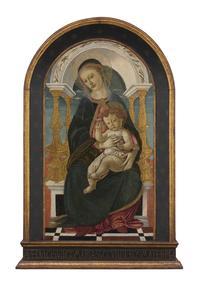
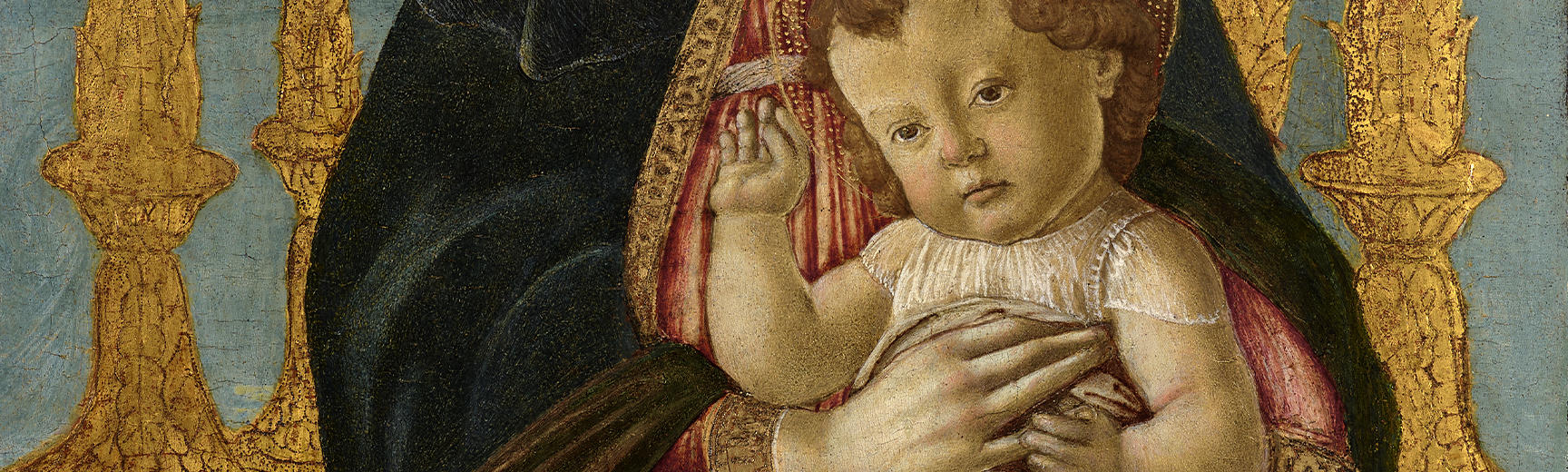
The Virgin and Child Enthroned depicts the Virgin Mary seated with the Christ Child. It was probably created for private devotion. Painted in about 1470, when the young Botticelli was establishing himself in Florence, it reveals the artist's distinctive treatment of the human figure, particularly the delicate details of the Virgin's face.
The painting is unusual for its generous use of gold leaf. Although earlier Italian painters regularly applied gold to the backgrounds of their devotional works, it was less widely used by Botticelli's time. Botticelli, who is thought to have trained as a goldsmith before becoming a painter, continued to explore its decorative possibilities. The painting will join the Ashmolean's distinguished collection of Italian Renaissance art, which includes a newly acquired Crucifixion by Fra Angelico.
Oxfordshire history
The Botticelli has a longstanding connection with Oxfordshire. It was acquired in 1904 by Harriet Sarah Loyd-Lindsay, Lady Wantage, a noted art collector and philanthropist, and became part of her collection of Old Master paintings at Lockinge House, near Wantage. The painting remained in the family's collection for more than a century. Rarely seen by the public, it was displayed at the Ashmolean in 1934–5 as part of an exhibition of paintings from Lockinge House, before returning to its home in the Wantage collection.
New conservation
The painting underwent conservation over the summer 2026, which removed discoloured varnish and later retouching. The treatment has revealed well-preserved details of the Virgin and Child and restored the original cooler tones. The painting has also been fitted with a new, hand-carved arched frame, inspired by fifteenth-century Florentine examples.
A. Gary and Dr Anita Klesch, say: ‘We are delighted to share this painting with the public and to see it return to the Ashmolean Museum, an institution closely connected to its history. We are grateful for the museum’s partnership in bringing this work to a wider audience and helping to preserve and celebrate its cultural legacy today and for generations to come.’
ENDS
Contact details
Claire Parris
Strategic Communications Manager, University of Oxford Gardens, Libraries and Museums
press.office@ashmus.ox.ac.uk / 01865 278 178
The Klesch Collection: https://thekleschcollection.com/
Press images
Images for editorial use are available to download at: https://go.glam.ox.ac.uk/Botticelli
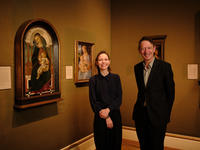
Image above:
Dr Xa Sturgis CBE, Director of the Ashmolean with Dr Imogen Tedbury, Curator of Southern European Art, Ashmolean Museum, with Botticelli’s The Virgin and Child Enthroned at the Ashmolean Museum
© Andrew Bailey, 2026, courtesy of the Ashmolean Museum, University of Oxford
Painting details
Alessandro di Mariano Filipepi, called Sandro Botticelli (1444/5–1510)
The Virgin and Child Enthroned, c. 1470
Tempera with gilding on panel, 83.3 x 44.9 cm
Photo: The Klesch Collection
Provenance
Oratorio of San Giuliano, in the Convent of San Giuliano, which was later bought and rebuilt by the Calasanzian order, via Faenza, Florence, by the early 19th century; placed in the chapel of a convalescent home for the sick brethren of the Calasanzian Order or Scuole Pie of Florence, Comezzano, near Vaggio, Figline Valdarno, Province of Florence; by inheritance with the property to the Graziani family, remaining in situ until about 1900; Giovanni Magherini Graziani (1852–1924), Poggitazzi, Terranove Bracciolini, near Arezzo, and via Pinti, Florence; by whom sold, in November 1903, to the dealer Elia Volpi, Florence; from whom bought by Harriet Sarah Loyd-Lindsay, Lady Wantage (1837–1920), in May 1904, for £5,000; thence by descent at Lockinge House, Wantage, and from 1947 at Betterton House, near Wantage, Berkshire; by whom sold (‘Property from the Loyd Collection’), London, Sotheby’s, 4 December 2024, lot 3 (as Botticelli), for £9,960,000 (incl. premium); placed under a temporary export bar in May 2025 and subsequently acquired by The Klesch Collection in 2026.
The Klesch Collection was founded by A. Gary and Dr Anita Klesch and holds European paintings from the fifteenth to seventeenth centuries. It includes works by Caravaggio, Sofonisba Anguissola, Rubens and Arcimboldo, which are regularly lent to museums and public institutions.
The Ashmolean is the University of Oxford’s museum of art and archaeology, founded in 1683. Our world-famous collections range from ancient Egypt to contemporary art, telling human stories across cultures and across time.
Admission: free
Open: daily, 10:00-17:00

