

SOUTHERN & NORTHERN NETHERLANDISH DRAWINGS PROJECT

Researching and cataloguing over 800 drawings produced in the modern-day regions of Belgium and The Netherlands from 1450 to 1800
This research project was initiated in 2022 while preparing the Ashmolean Museum’s exhibition Bruegel to Rubens: Great Flemish Drawings (23 March – 23 June 2024) and is ongoing.
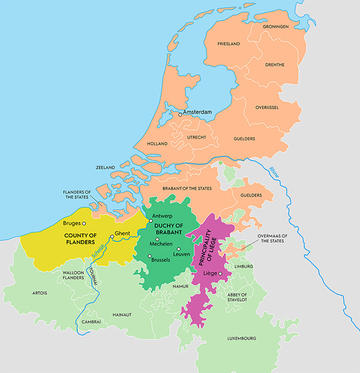
Simplified map of the Northern and Southern Netherlands in the 16th and 17th centuries
Research aims
The project aim is the systematic study and cataloguing of more than 800 drawings produced between 1450 and 1800 by artists born and/or active in the regions corresponding to present-day Belgium, The Netherlands, Northern France and Luxembourg.
Combining traditional drawings scholarship with digital approaches, the project seeks to reassess this significant but under-researched part of the Ashmolean’s collection.
Despite the exceptional quality of the drawings, the group had never been fully catalogued and required sustained research into questions of attribution, iconography, and function.
About the research project
The collection includes works by major figures such as Lucas van Leyden, Pieter Bruegel the Elder, Peter Paul Rubens, Rembrandt, Anthony van Dyck, and Jacques Jordaens, alongside numerous others.
Just over 250 drawings were published by K.T. Parker in his 1938 collections catalogue, but the present project aims to produce the first comprehensive catalogue of the drawings collection, including works acquired since that date.
Earlier attempts to update Parker’s catalogue date back to the early 1980s, when, under the directorship of Dr Christopher White, Jane Turner undertook preparatory research, primarily on the Dutch drawings. Although this work remained unpublished, Turner’s confidential research files – now preserved in the Western Art departmental archives – have been consulted for the current project with her generous permission, allowing continuity with earlier phases of scholarship.
You can view the digital records for this catalogue of drawings, with accompanying research information, on the Online Catalogue on Collections Online.
VIEW THE SOUTHERN & NORTHERN NETHERLANDISH DRAWINGS ONLINE CATALOGUE


Research undertaken during the course of the project has drawn on, and contributed to, a range of related scholarly activities. An Van Camp’s individual publications informed the project’s methodology and case studies, including a survey of the Ashmolean’s cartoon fragments for the papal Scuola Nuova tapestry cycle, produced in a Brussels workshop.
Further in-depth research was carried out in preparation for the exhibition catalogue Bruegel to Rubens, which brought together over 120 drawings from the Antwerp and Oxford collections, including just over 40 sheets from the Ashmolean, and which directly fed into the cataloguing of the Ashmolean holdings.


Of particular importance to the project were an experts’ meeting and a public study day organised in May 2024 in conjunction with the Bruegel to Rubens exhibition, which brought together over a dozen leading international specialists in the field of Southern Netherlandish drawings.
More recently, the GLAM-SPK branch of the Oxford–Berlin Research Partnership generously supported further research through a two-week exchange between the Ashmolean Museum and the Kupferstichkabinett (Staatliche Museen zu Berlin), undertaken by An Van Camp and Christien Melzer between October 2025 and January 2026.
Material-technical research was also conducted in parallel, in close collaboration with the Ashmolean’s Paper Conservation team and Oxford’s ArchiOx (Analysis and Recording of Cultural Heritage in Oxford) programme, examining the papers and their watermarks, as well as informing questions of technique, condition, and function.
An Van Camp would like to thank Maud van Suylen, Sophie Croasdale, Sophie Scott, and Bianca Arthur-Hull for their assistance over the years on this project.
This catalogue of drawings represents an ongoing work in progress, and not all entries are equally exhaustive at this stage.
In January 2026, An Van Camp left the Ashmolean Museum to take up the post of Curator at the Rubenshuis in Antwerp. It is hoped that the project will continue in the future, further advancing the study and accessibility of this important collection.
Attributing drawings to artists
An attribution is the identification of the authorship of an artwork. Undisputed attributions can only be made when a work is signed, however, the majority of 16th- and 17th-century drawings were not marked as such by their creators.
Unsigned sheets can still be attributed to an individual artist if they can be compared stylistically to other signed sheets, or if they can be matched to other artworks, such as paintings and sculptures, which tend to be better documented or even signed. Even when no related work can be found, the characteristic style of an artist or the use of a specific medium, can lead to an attribution, albeit tentative in some instances.
Because attributing works of art remains challenging, degrees of certainty must be expressed. The following terms have been used throughout the digital collections catalogue:
- By [or simply the name of the draughtsperson]: firm attribution
- Attributed to: very likely, but more evidence might be needed for the attribution to be fully accepted
- Workshop/Studio of: an unnamed draughtsperson working in the workshop of the artist, often a collaborator or assistant supervised by the artist
- Circle of: an artist working close to the artist but not working directly in his workshop
- Follower of: an artist working in the same style, often later in date than the artist
- After: when the composition is after a known work
- Anonymous: when the draughtsperson is unknown
Project funders
- Funding for the project was provided by the Diplomatic Representation of Flanders to the UK and by the GLAM-SPK Flexible Seed Funding stream, part of the Oxford–Berlin Research Partnership.
- Support from the Diplomatic Representation of Flanders enabled the organisation of an experts’ meeting and a public study day held on 23–24 May 2024
- GLAM-SPK funding facilitated a two-week research exchange on Southern Netherlandish drawings with Dr Christien Melzer, Curator at the Kupferstichkabinett (Staatliche Museen zu Berlin).
Together, these funding streams enabled focused curatorial research on selected Southern and Northern Netherlandish drawings, with particular emphasis on works produced in Antwerp during the 16th and 17th centuries.
They also supported the digital dissemination of the drawings to both scholarly and wider audiences through the publication of a digital collections catalogue, including new high-resolution photography of many of the sheets.
Project dates
- 2023 – present
Project team
Project Lead
Participants
- Stijn Alsteens (International Head, Department of Old Master Drawings, Christie’s, Paris)
- Maarten Bassens (PhD candidate, University of Leuven): participant in experts’ meeting and speaker at study day
- Virginie D’haene (Curator, Museum Plantin-Moretus, Antwerp): co-curator of “Bruegel to Rubens” exhibition, participant in experts’ meeting and speaker at study day
- Robert Fucci (Lecturer in History of Art, University of Amsterdam): participant in experts’ meeting and speaker at study day
- Ryan Gregg (Associate Professor of Art History, Webster University): participant in experts’ meeting and speaker at study day
- Olenka Horbatsch (Monument Trust Curator of Dutch, Flemish and German Prints and Drawings, British Museum, London): participant in experts’ meeting and speaker at study day
- Cécile Kruyfhooft (private collector, Antwerp): participant in experts’ meeting
- Christien Melzer, partner Oxford–Berlin Research Partnership (Curator of Netherlandish and British Art before 1800, Kupferstichkabinett, Berlin)
- Greg Rubinstein (Senior Director and Head of the Old Master Drawings Department Worldwide, Sotheby’s): participant in experts’ meeting and speaker at study day
- Joris Van Grieken (Curator, Royal Library of Belgium, Brussels): participant in experts’ meeting and moderator at study day
- Ilona van Tuinen (Head of the Rijksprentenkabinet, Rijksmuseum, Amsterdam): participant in experts’ meeting
- Jane Turner (Former Head of the Rijksprentenkabinet, Rijksmuseum, Amsterdam): participant in experts’ meeting and moderator at study day

